
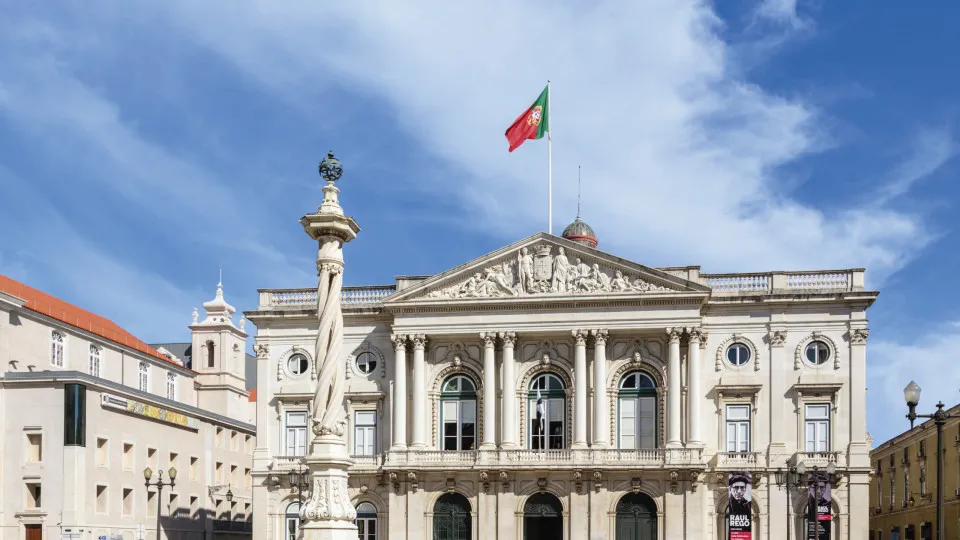
“We believe it’s a good budget,” stated Gonçalo Reis (PSD) during the presentation of the proposal at the Town Hall.
The Finance officer noted that both the expenditure and the revenue expected for the coming year are each valued at 1,345 million euros (ME).
“It is a balanced, secure, and prudent budget, and it’s not just about the balance between revenue and expenditure. We comply with all ratios, all good governance rules, and all principles of prudent and sustainable management with tranquility,” said the vice president.
Gonçalo Reis mentioned that this proposal, presented three weeks after the inauguration of the current municipal executive, aims to ensure the smooth operation of Lisbon’s City Hall, intending to come into effect “already in January 2026.”
“There are great advantages in predictability,” he emphasized, highlighting the PSD/CDS-PP/IL leadership’s choice to present the document “as quickly as possible” to ensure the municipality operates “without surprises.”
The Finance officer also highlighted the priority on investment, foreseeing a growth of 30%, from 313.7 ME in 2025 to 410.2 ME in 2026, while current expenses are expected to increase by 7.5%, from 800.3 ME to 860.4 ME.
The proposal is “very prudent” in financing, with a 55% reduction in bank financing, from 101 ME in 2025 to 45.5 ME in 2026.
“We are even conservative; we are restrained, and we will demonstrate this: there are no new loans, there is stabilization of the debt value, and well below the available margin,” he explained.
Gonçalo Reis further stated there is a focus on key issues for Lisbon residents, allocating funds and focus on high-impact initiatives, in a set of 15 measures planned for the Large Options of the Plan 2026-2030, including a new urban hygiene management model, security plan, 13 new municipal facilities, creation of new housing neighborhoods and green parks, the Lisbon-Oeiras metrobus, and new tram 16 Lisboa-Loures.
Other measures include the reduction of municipal rates, combating excessive bureaucracy, creation of 30,000 jobs with the Unicorn Factory, end of zero licensing, and reinforcement of illegal commerce control, the Culture on the Street program with more art and performances in public space, Baixa Pombalina UNESCO World Heritage, and Lisbon as the European Capital of Contemporary Art.
Regarding the slight decrease between the 2025 budget and the forecast for 2026, Gonçalo Reis justified it by stating that the Recovery and Resilience Plan (PRR) is ending, noting that the estimated amount for the coming year represents an 18% growth compared to the total estimated amount executed this year, approximately 81% of the 1,359 ME.
Regarding revenues, estimated at 1,345 ME for 2026, with 576.7 ME in direct taxes, the vice president praised the maintenance of tax rates, with the full return of the Individual Income Tax (IRS) to Lisbon residents, 0.3% of Municipal Property Tax (IMI) for urban buildings, and 1.5% of Surcharge.
In direct taxes, the city council anticipates growth in 2026 compared to the values collected this year, with the revenue from the Municipal Property Transfer Tax (IMT) rising from 282 ME to 291 ME, the IMI from 132 ME to 139 ME, and the Surcharge from 120 ME to 128 ME, while the Single Circulation Tax (IUC) will remain at 18 ME.
This is the first municipal budget of the current term (2025-2029), proposed by the new PSD/CDS-PP/IL management, under the re-elected Carlos Moedas (PSD) presidency, continuing to govern Lisbon without an absolute majority.
In the previous term (2021-2025), the four budgets of the PSD/CDS-PP leadership (the IL did not integrate the municipal executive) were approved due to PS abstention, with the remaining opposition – PCP, BE, Livre, and Cidadãos Por Lisboa (elected by the PS/Livre coalition) – voting against.
In this year’s 2025 municipal budget, the city council estimated an expenditure of 1,359 ME, slightly higher than the 1,303 ME forecast for 2024.
Currently, the executive, composed of 17 members, includes eight elected from the PSD/CDS-PP/IL coalition, who are the only ones with assigned portfolios and govern without an absolute majority. The opposition includes four PS councilors, two from Chega, one from Livre, one from BE, and one from PCP.
[Updated at 16:09]