Two center-right ministers have submitted their candidacies for the Eurogroup presidency: Greece’s Minister of Economy and Finance, Kyriakos Pierrakakis, and Belgium’s Deputy Prime Minister and Budget Minister, Vincent Van Peteghem.
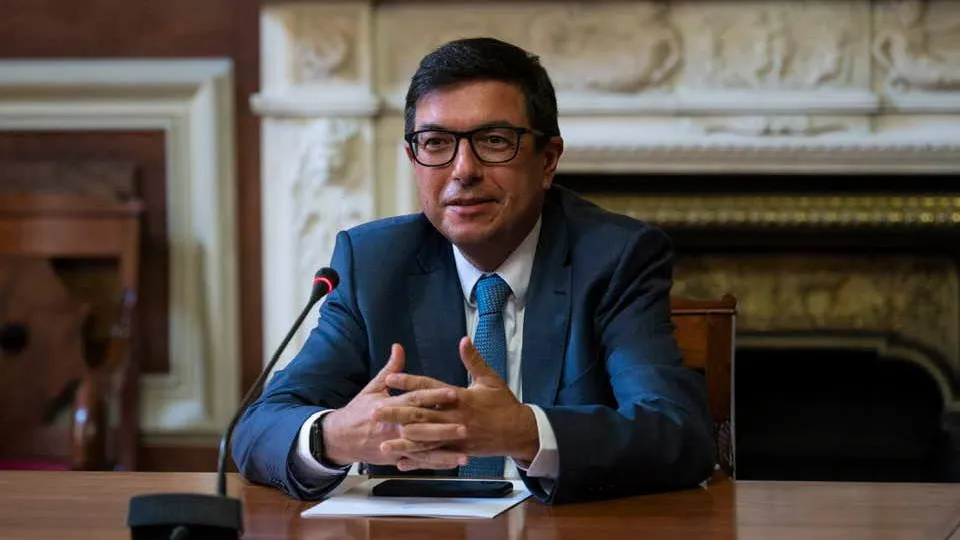
Portuguese Finance Minister Joaquim Miranda Sarmento was on the European People’s Party list to run for the position but opted not to, to avoid internal divisions within the center-right group, according to sources familiar with the process.
Today’s vote follows the departure of Paschal Donohoe, who stepped down in late November as Eurogroup president after being reelected recently, to assume the role of Executive Director at the World Bank.
Paschal Donohoe was first elected Eurogroup president in July 2020 and reelected in December 2022 and in July 2025.
He succeeded Mário Centeno, who chaired the informal body as Portugal’s Finance Minister from January 2018 to July 2020.
In a statement released in Brussels, Paschal Donohoe described the “opportunity to serve as Eurogroup president” as “one of the greatest honors” of his professional life, recalling challenges such as the COVID-19 pandemic, record inflation due to the Ukraine war, and new community priorities.
Meanwhile, Cyprus’s Finance Minister Makis Keravnos assumes the role of interim Eurogroup president, given the Cypriot presidency of the EU Council in the first half of 2026.
Any minister responsible for finance in a eurozone country can be elected Eurogroup president, provided the candidate is an active member of the body at the time of election.
The Eurogroup president presides over meetings, sets agendas, formulates long-term work programs, and represents the Eurogroup in international forums.
Members of this body elect their president for a two-and-a-half-year term by a simple majority of votes, requiring at least 11 of the 20 votes.
If no candidate achieves this simple majority in the first round, candidates may withdraw, with voting continuing until such a majority is achieved.
The Eurogroup is an informal body created in 1997, comprising the finance ministers of the eurozone states to closely coordinate economic policies.