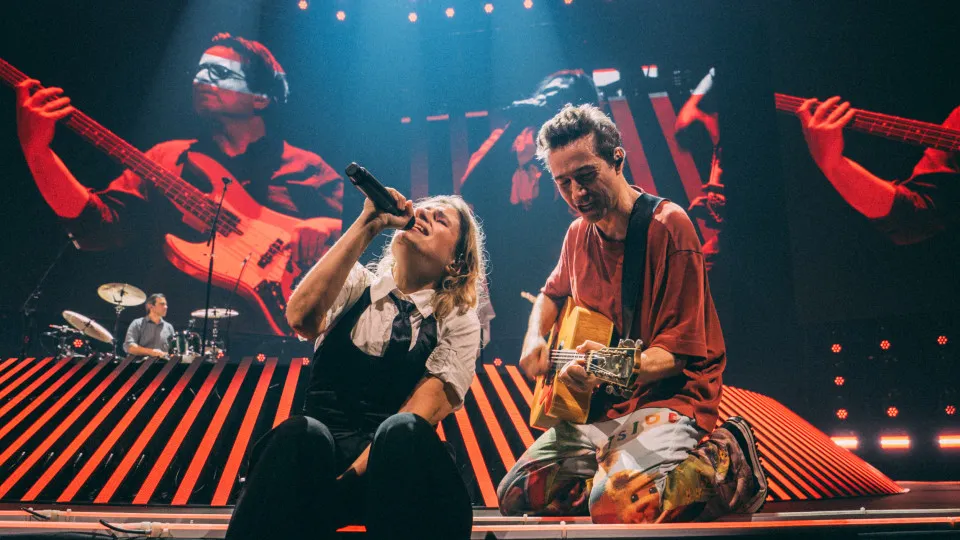
Days before taking the stage at the Meo Arena in Lisbon, the Silence 4 created a space at LX Factory for fans to revisit the band’s history. The room was meticulously arranged to allow visitors to travel back in time, to the band’s beginnings in Leiria in the 1990s.
“It’s a kind of replica of what our first rehearsal room was like, how our space was, and how we actually started making music,” said David Fonseca, speaking with Notícias ao Minuto from the very same room.
“We have recreated the Silence 4 space as it was in ’95, when we started with two guitars and a drum set, without amplification. We’ve reproduced that space and brought in several elements from our history, like bands, photos, and moments before, during, and after the great success of Silence 4. Our first demo is here,” the singer further elaborated.
This space will be open to the public until Saturday, December 13, which marks the end of the band’s 30th-anniversary celebrations at the Meo Arena in Lisbon.
The name Silence 4 quickly evokes memories of hits like “Borrow,” “To Give,” or “A Little Respect.” With two studio albums and sold-out venues across the country, the project was successful from the start, and the band admits they still have “no idea” how they achieved such rapid success. “It’s impossible to predict success of this kind.”
During the interview with Notícias ao Minuto, David Fonseca, Tozé Pedrosa, and Rui Costa also reminisced through some stories that marked the band, especially in the late ’90s. It’s worth noting that Sofia Lisboa is also a voice of Silence 4.
Today, how do you recall the beginning of Silence 4?
Tozé Pedrosa (TP): It was a very fraternal moment, somehow, sharing ideas, experiences, tastes, which also resulted in the music that David composed and in the ensemble as a whole. It was a moment of sharing and experiences that resulted in that music. We had no idea what could happen, but it was something we enjoyed doing and wanted to show to the public.
From the first concerts we played – like in a bar called Opus – we started to realize that there were other people who also liked the music. Things grew from there, and the rest is history.
What is the feeling when you ‘pause’ the concert and realize that nowadays people still know the lyrics, are singing along?
Rui Costa (RC): It’s a fantastic and surprising feeling because we weren’t expecting people to be receptive to all of this again. Now parents bring their children. We have 8, 9-year-old children attending the concerts – like what happened at the Super Bock Arena – Pavilhão Rosa Mota. We had a very diverse audience there.
The process is very interesting because we chose an intimate stage. We are closer to each other than when we reunited in 2014. We managed to transport our first rehearsal room to a Meo Arena, and that’s what’s interesting, it makes us feel very supported by each other. We support each other, and it’s a magnificent feeling to be there playing.
David Fonseca (DF): I would go even further. I think this is the first time we play so close to each other. Normally, when we started playing on bigger stages, there was a lot of pressure to fill the stage, each one on their end, and it was complicated for everyone.
Now we wanted to do it like the band used to be, all close together, and there’s a different sense of playing with people, literally all close together. We feel more supported, in reality. It’s an old-fashioned band, we don’t have backing tracks, everything that’s happening is happening right then. It’s something that’s very important for a musician, to feel that closeness to the others, because it only works when everything is aligned and happening simultaneously. It’s good.
When I wrote, I thought it was all about me, and now I think the songs are everything but about me (…) I prefer to remember the songs for what they became and not for what gave birth to them
The lyrics of Silence 4’s songs carry a significant emotional weight and remain relevant over time. What does it mean to David to realize that his words have this impact on people’s lives?
DF: It’s very strange, mainly because most of these songs were written when I was very young, and they all somehow narrate existential teenage problems, a late adolescence, unrequited loves… And today, it has a different weight for me, I look at the lyrics in a completely different way.
However, they are lyrics that talk about extremely universal feelings, not specific to anything that only I could understand, quite the contrary. This universality has allowed them to be carried over the years without blemish. We arrive today, and I can still listen to the song, sing it, and realize it’s a lyric that can still reach anyone else, that hasn’t aged, that isn’t stuck to a certain day or a certain generation.
It’s something very positive, but today I see it differently. When I wrote, I thought it was all about me, and now I think the songs are about everyone but me. They are about people, about the people who listened to them, and I find that much more interesting than them being about me. Honestly, I don’t even remember what triggered half of them, because what happened afterward was so much stronger that I prefer to remember the songs for what they became and not for what gave birth to them.
And singing in English was never with the aim of internationalization, it was just what came naturally?
DF: It was us, it was what was happening, the songs were like that. The first time someone asked why we sang in English was when we sent things to the record label because not even my bandmates ever asked me why it was in English. It was something that never crossed anyone’s mind. We were just doing it. It only became an issue much later. Even after releasing the album, there was an attempt to make it a huge problem, but luckily it wasn’t.
Bands and artists need to be genuine, faithful to an idea, and we have a pure honesty in everything we did and continue to have
In fact, as soon as you released the first album, you achieved success. I believe at the time, you didn’t fully understand what was happening. Can you understand it now?
RC: I can’t understand it, nor am I interested in understanding it. We don’t self-analyze our career. We continue to enjoy immensely, doing what we want with complete freedom, and the rest we don’t care about. It happened.
We have the responsibility to play the songs well, and I think we are playing much better now, which might be due to the proximity that exists. We spent two or three years locked in a house in Reixida, a village in Cortes near Leiria, and sometimes we received letters saying “you should sing in Portuguese” and we ignored them. Why? Because we were crazy, we just wanted to do it. We would follow this path and not deviate, and we didn’t.
DF: But that question of why this project was successful, I have no idea, I think none of us does. If it was understood why many would do the exact same thing. It’s impossible to predict success of this nature. They are not easy things to explain when they happen. They happen because it happened at that moment, that year, with this band, with these songs, because it had to happen.
RC: There’s something very important, bands and artists need to be genuine, faithful to an idea, and we have a pure honesty in everything we did and continue to have. We do what we feel like, and people also feel that. Somehow it helps people identify because we are not trying to adapt to anything.
I remember many times being in improvised dressing rooms – usually in bathrooms – sitting in rows at three in the morning, with a DJ playing and us waiting to go on
Then there were many concerts that must have been a great adventure but also very exhausting.
TP: In the first year, no, it was more challenging in the sense there were many concerts. We had about three or four a week, sometimes more than one in a day, and it was difficult to manage. But by the second year, things were smoother though we were still in high demand. That part perhaps was tougher for us to manage – between band time and individual time.
Perhaps it also created some less-positive consequences. But it was what was happening, what we enjoyed doing, and we had to seize the moment. We were enjoying those moments as much as possible. It was all done with much pleasure, with great enthusiasm.
DF: In the first year, we played a lot in a circuit that no longer exists, which is the nightclub circuit. We did many nightclubs, and one thing I remember about that is that we played very late because discos wanted to make money selling drinks. I remember many times being in improvised dressing rooms – usually in bathrooms – sitting in rows at three in the morning, with a DJ playing and us waiting to go on. And I thought, right, our life now is this, we’re in bathrooms waiting to go on stage [laughs]. If there is an age for living that, it was the age we had. Maybe today we wouldn’t have the necessary endurance or patience.
But at the time, everything felt like an incredible adventure. Then there was the life of the van, the hotels, waking up who knows where and getting very little sleep… It was all worth it. The first year was one of those things that happen once in a person’s life, especially for a band that is successful.
RC: And a small band from Leiria.
It was funny because people would be outside the hotel singing the songs. I remember once there were kids chasing our van for about 50 meters
DF: And we had a big self-sabotaging factor. We didn’t view things too seriously; it all seemed very funny to us. It was funny because people were outside the hotel singing the songs. I remember once when kids chased our van for about 50 meters, running, and I asked to stop the van because I couldn’t bear watching them run after us. There were indeed funny things happening, which were good and funny to witness, extremely innocent things.
In the ’80s, ’90s, there was still some innocence about what projects were, what the world was like, there weren’t many mobile phones, none of that. We still lived in that golden period of band success, which is extremely rare in Portugal.
Now that you mentioned it was a completely different time, there have been some shares on Instagram, and David was the most proactive person concerning audiovisuals. Can you imagine how Silence 4 would be today with David Fonseca responsible for social media content?
DF: It would have been crazy. Sometimes I think about that, about how hard we worked back then to do something that’s so easy today. I remember, for example, how difficult it was to do promotional photographs. I remember that I took the band’s photos, but then had to develop them, enlarge them in an improvised studio at home. Everything took a long time. I don’t think that’s bad, because I learned, and I think we all learned, to be more resilient in pursuit of things. Nothing happened in 10 minutes, nothing. Today it’s possible to do something and in an hour it’s practically ready and spectacular.
RC: We had to fight a lot.
It was already, in truth, way ahead of its time…
RC: It was ahead of its time. For example, there’s a photo there at Abbey Road, which was a selfie David took, there were no mobile phones…
DF: I remember one of the silliest things I did was when we came to play at the Ritz Club, which no longer exists, here in Lisbon, a concert we organized ourselves. I remember Rui was the one in charge of dealing with the technical sound part.
RC: In fact, at the start of the concerts, I was the sound technician.
DF: As I was studying in Lisbon, I was in charge of promotion. I remember that at the place I lived, which was a student residence, there was a fax machine. I went through the trouble of, four days before the concert, sending a fax to all the newspapers in Lisbon, like Público and Diário de Notícias, for example. Four days before, I sent a fax with just the number 4. Then when it was three days, I sent one with just three. The day after, just two. On the day before the concert, only one, and on the concert day, one saying Silence 4 today. So I was doing promotion by fax to newspapers. How many newspapers showed up? None [laughs].
RC: But the idea was genius.
DF: The idea was good, but the impact was zero. There was a strong desire to do different things, but we didn’t have the means to do it. Honestly, I prefer how things are today. Especially for kids starting today, the fact that they can make an album in a room with a computer is one of the most incredible things. Who says an album, says a film, photography… They don’t really depend on something extremely expensive and technical to achieve that goal.
Silence 4 didn’t record earlier, in reality, because to record music professionally, we needed conditions in the studio that none of us could financially support. We depended heavily on a record label for that to happen. Nowadays, that’s not the case. I like to think that somewhere in the world there’s a kid who doesn’t even know the difference between C and D and can create something just with their mind and the help of technology. I find that absolutely extraordinary.
What there is most in the art world is rejection. The idea of doing something creative implies someone on the other side not liking at all what a person does, and we must accept that
And with it being easier to create, is there always room for everyone?
DF: There has never been room for everyone, in reality. That idea that when a person creates something, they are immediately saying they have their space because they did something, isn’t true. What there is most in the art world is rejection, be it from platforms, or the public… If you can’t handle that, there’s no point being in a creative field, whatever it is.
The idea of doing something creative involves the idea of someone on the other side not liking what a person does, and we must accept that. Sometimes it goes well, other times it doesn’t. I’m sure each of us has done creative things that weren’t well received, and they didn’t go well, but that’s part of the journey.
There’s room for all talents. I doubt that people who are extremely talented don’t have their own space. When it doesn’t happen, it’s unjust.
In the end, we became a result of a series of limitations. And limitation is an extremely important thing in creation
Silence 4 marked the end of the ’90s and early ’00s, perhaps because of your acoustic vocation which was novel at the time, different from everything happening in Portugal. Nowadays, considering the evolution of the music scene, if Silence 4 had not existed 30 years ago and launched now, would it be in the same style or have a different musical style?
DF: I really have no idea.
RC: I’ve always loved the acoustic style. Although I’m a bassist, my favorite instrument is the acoustic guitar. I joined last, and back then, when they were already working, the style was electric. It was completely electric, almost a haunting [laughs]. It wasn’t very good yet, and there weren’t good instruments or sound systems – it was horrible.
The suggestion I made was to unplug everything and work on the details, the small things, starting from scratch. They agreed, and it grew and became something very interesting. And the songs, as they are good, can live on their own, they don’t need big electric accompaniments. We have the freedom to do whatever we want. On the second album, we had a string orchestra, but the acoustic side was always present. I think it would happen again.
DF: I find it amusing because, in the end, we became a result of a series of limitations. And limitation is an extremely important thing in creating something. Not being able to do everything is not necessarily a bad thing, quite the contrary. It forces us to think. Today, the reality is if you want to include an orchestra in five minutes in a song, you can. I don’t know if the fact that today we have so many things available and possible doesn’t make it more complicated.
RC: Sometimes it cuts a bit of the creative work. People get lost in technology.
DF: For me, the most important things in a creative act are, by far, the walls put around it. Back then, the walls were intense. We didn’t have equipment, we had nothing, and Rui came with this suggestion of doing it acoustically, and it was the best suggestion ever. We had to find many different things, Rui had to rethink the guitar, I had to rethink the harmonies we made with Sofia differently to occupy all that space… We pushed ourselves there. I don’t know if today it would be so simple, honestly.
RC: For me, it would be.
DF: For me, it wouldn’t be. There are too many options, options are too many. It’s terrible.
I still like to think that we’re all professional amateurs today
At the time of your launch, there was an interview with David in the Blitz newspaper where they asked if 1998 was the first year of the rest of your lives. I’m asking you the same today: was 1998 the first year of the rest of your lives?
DF: I don’t think so. I always think that every year can be the first year of the rest of my life. I don’t have the notion that there’s a year that starts something and then it becomes eternal because I think the present time is always different, in reality. If I look back, maybe I could also say that when I entered university, it was the first year of my life or when I started dating for the first time, it was also the first year of my life…
TP: I also have that idea a bit, but I recognize it had a big impact.
RC: Yes. If we speak in terms of the band and not individually, it did indeed have an impact.
DF: Yes, it had a huge impact.
RC: The fact that we closed Sudoeste a little at the last minute, that was striking and changed our lives a bit.
DF: And we were a weekend band, amateur, and we went from that to being a professional band that became part of the Portuguese musical universe. Whether we like it or not, suddenly we were there with Sérgio Godinho, Pedro Abrunhosa, or Delfins…
There have been millions of songs in the meantime, and yet there we are playing those songs and still having that impact – people crying, people laughing, hugging…
Who were references at the time?
DF: Who were suddenly our professional colleagues. A very strange thing for us. I still like to think that we’re all professional amateurs today.
RC: Not to take it too seriously.
And who are Silence 4 today?
DF: They are the same people, honestly. Especially the band, we managed something very difficult to have, which is to have the same strength that existed when we made the songs. When we were playing in ’98, ’99, and 2000 and stepped onto the stage, we saw the impact that had on people… I feel exactly the same now when we did these concerts at the Super Block Arena.
We managed to have that impact on our songs, how we did it, how we built those songs. That’s an incredibly rare thing, especially because so many years have passed, millions of songs have occurred since, and yet there we are playing those songs and still having that impact – people crying, people laughing, hugging…
I don’t really understand how this is possible, but it is possible, and that, obviously, makes us very happy. It shows that the band continues to have in its core that strength and impact on people.