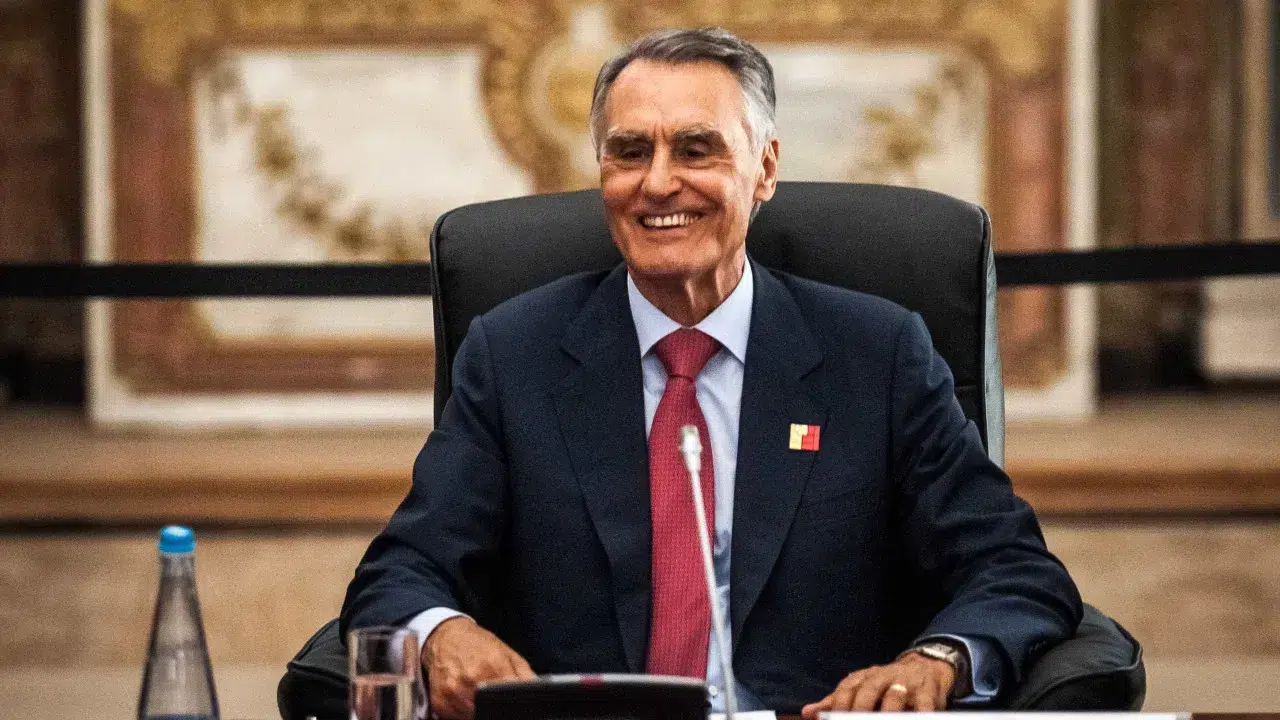
Former President and Prime Minister of Portugal, Aníbal Cavaco Silva, has expressed his support for Luís Montenegro, stating that the policies advocated by Montenegro before the political crisis leading to the call for early elections are a reliable indicator of the policies that will be pursued in the next legislature.
In a commentary for Observador, Cavaco Silva noted that, based on his observations until the political crisis precipitated the government’s fall, “the current Prime Minister, Luís Montenegro, has shown commendable qualities in key technical issues across different ministries, effective leadership in government, and in defending national interests within the European Union, qualities I do not foresee in other party leaders.”
Cavaco Silva further noted that, upon objectively assessing the behaviors and attitudes of various opposition party leaders, he found no “superiority over the current Prime Minister in terms of ethical and moral conduct in political life.”
He explained, “My choice of Prime Minister is based on three criteria: political and technical capability, ethical dimension in political life, and the government’s general policy proposal.”
“Error corrected as proof of good faith,” stated Cavaco Silva.
“Luís Montenegro initially made a mistake in judgment concerning what, in times of intense competition among media outlets, some demand to know and publicize about politicians’ personal lives. It was an error that he subsequently corrected superbly, proving his good faith,” said the former Prime Minister concerning the controversy surrounding Montenegro’s family business, Spinumviva.
The former head of state further stated that “the campaign of suspicions and insinuations” by political opponents aimed “to create a political climate so inflamed and paralyzing to government action” that the only option was “to confront the Assembly of the Republic with a motion of confidence.”
He accused, “It was the opposition’s rejection of this motion that led to the government’s resignation and the calling of early elections.”
On legislative elections, Cavaco Silva commented that the party programs are merely updates of the ones from the elections held just over a year ago.
“Thus, the policies they advocated until the political crisis leading to the early elections are a reliable indicator of those they will defend in the next legislature,” it read.
Cavaco Silva also noted that “the government’s general policy proposal to be executed by the Prime Minister […] is another important factor in choosing the party leader for these functions, although inseparable from his technical and political capacity.”
“In my opinion, the policy guidelines advocated by the ‘AD–PSD/CDS Coalition’ are more suitable for the country’s development, improving family welfare, and providing a more promising future for young people than the proposals of other parties,” argued Cavaco Silva.
He emphasized, “These are non-dogmatic guidelines that duly consider the constraints imposed by the economic and social realities of new times, such as globalization, European integration, technological development, the information society, the assertion of supranational powers, and current geopolitical and geoeconomic turmoil.”
Aníbal Cavaco Silva also pointed to “the obstacles created for the current government in the Assembly of the Republic by opposition parties” and “the obvious technical incompetence demonstrated by some of them,” reiterating that the Luís Montenegro government, “in its eleven months,” has acted in various areas, including “increasing purchasing power of wages and pensions, defending employment and financial stability, and improving the climate of confidence vital for preparing a better future for young people and bringing Portugal closer to the wealthiest EU countries.”
In concluding his commentary, the former Prime Minister stated that the, AD leader, Luís Montenegro, compared to other party leaders, “possesses clearly superior qualities in technical and political competence, government leadership capability, and in defending Portuguese interests within the EU.”
He also remarked that Luís Montenegro “is equal to none in terms of political ethics.”
Cavaco Silva reiterated that the “AD policies” are the “most suitable for Portugal’s progress in various aspects,” compared to the Opposition’s proposals.
“Only the ‘AD – PSD/CDS Coalition’ can generate a government that ensures the political stability the country greatly needs,” he reiterated.
It is noteworthy that the legislative elections are scheduled for May 18 and the electoral campaign has already commenced.