

A report released today by the wind energy association WindEurope and the company Hitachi Energy indicates that a renewable energy-based system could save the European Union (EU) 1.637 trillion euros by 2050, equivalent to 9% of the EU’s Gross Domestic Product (GDP) or the combined healthcare expenditure of the bloc.
This finding compares a scenario of electrification with massive expansion of wind and solar energy against a model of slow transition, with prolonged reliance on fossil fuels.
The report also suggests that by 2035, the renewable scenario would save “331 billion euros compared to the slow transition scenario.”
The deployment of networks and renewable energies, accounting for necessary investments, is economically more favorable than alternatives with greater reliance on nuclear energy, hydrogen, or carbon dioxide (CO2) capture, according to the study.
“A renewable energy-based system involves a significant increase in the proportion of electricity in the energy matrix. This electrification requires significant investments, especially in heavy industry. This was taken into account in the study. Even considering the necessary investment in electrification, the renewable-based scenario remains the most economical overall,” highlight the report’s authors.
The system with more nuclear energy, capture, and hydrogen would increase the energy bill by 487 billion to 860 billion euros by mid-century, when the EU has pledged to achieve climate neutrality, meaning only emitting as much CO2 as it can absorb.
The more aggressive renewable energy scenario would also reduce the EU’s energy import dependency from the 71% projected for 2030 to 22% in 2050, according to WindEurope and Hitachi Energy.
“Conversely, in the slow transition scenario, dependency remains at 78% in 2030 and 54% in 2050,” the authors state, adding that the renewable energy-based system would also have positive effects on the labor market.
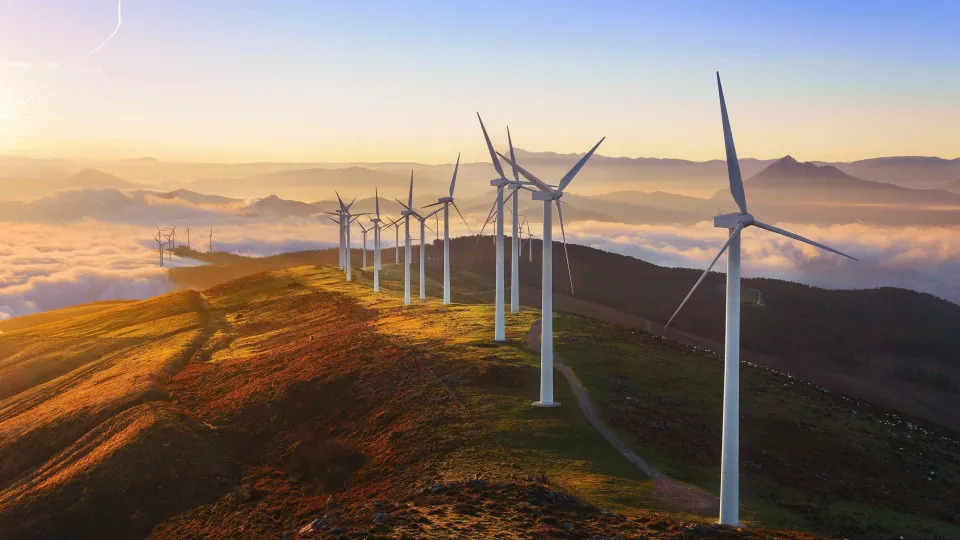
The European wind industry currently employs 440,000 people and will employ 600,000 by 2030, according to industry calculations.
“This transition is underway. Looking to 2050, it is worth remembering how our energy system was 25 years ago. In 2000, the combined share of wind and solar energy in European electricity was 0.8%. Today it is 30%. And European emissions have been reduced by nearly a third since 2000, while the economy has grown by 45%. Let us continue building on this success,” summarizes WindEurope.