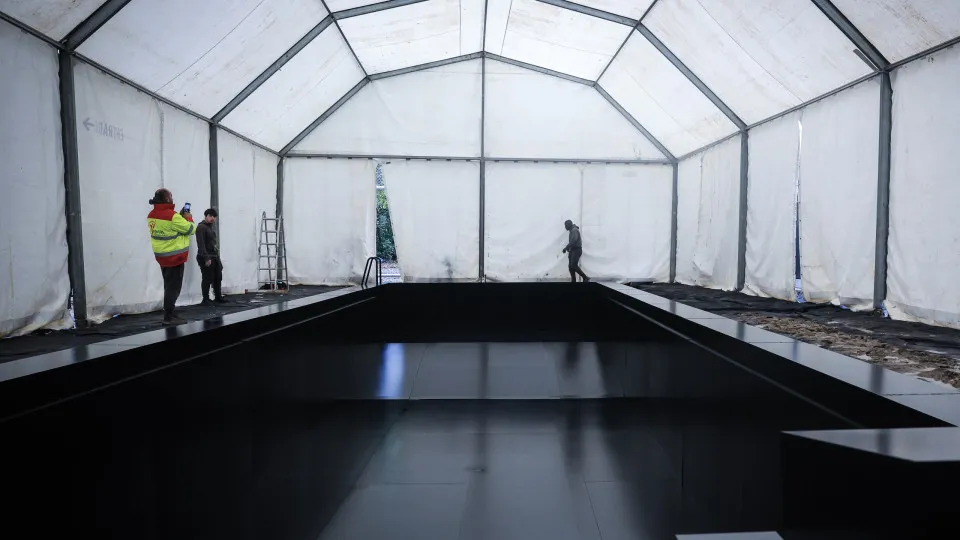
The Serralves Museum today unveils the exhibition “Fun ist ein Stahlbad” (“Fun is a Steel Bath”) by Anne Imhof, the artist awarded the Golden Lion at the 2017 Venice Biennale. The central piece is a black pool sculpture, constructed in iron, without water, approximately 20 meters long, installed outdoors in the Patio do Ulmeiro beside the Serralves Contemporary Art Museum in Porto.
The artist was reportedly inspired after a visit to the Leça da Palmeira Tidal Pools in Matosinhos (Porto), designed by architect Álvaro Siza, as revealed today by Inês Grosso, chief curator of the Serralves Museum, during a press preview of the exhibition.
“We visited Siza’s Tidal Pools, and immediately afterward, she wrote to me saying she would love to create a pool and started sending me sketches,” recalled the curator.
Inês Grosso also noted that Álvaro Siza Vieira’s pools are public and reflect the idea of “leisure democratization,” which strengthens the exhibition’s playful theme, intertwined with the disciplined fun discussed by philosophers Theodor Adorno and Max Horkheimer.
“The exhibition’s title borrows a phrase from Adorno and Horkheimer in ‘Dialectic of Enlightenment’ (1947), in which the authors explore how the notion of fun, turned into a commodity, intertwines with subtle disciplinary mechanisms: a tension between promise and austerity that indirectly permeates the entire exhibition.”
The pool sculpture, 1.80 meters deep, serves as a “structuring element of the exhibition,” establishing a direct relationship with the building designed by Álvaro Siza.
Throughout the exhibition, visitors can also view large paintings of sea waves, clouds, and explosions, alongside video works that evoke feelings of abandonment, the instability of the present, and the unease of a time marked by environmental crises and diffuse discomfort.
The exhibition is described as a “sort of manifesto by the artist and a synthesis of Anne Imhof’s work,” stated Inês Grosso, adding that many pieces were specifically created for Serralves.
“These works were made for Serralves, produced with companies in the North in constant contact with the artist’s studio and architect Andrea Faraguna, who won the Golden Lion at this year’s Venice Architecture Biennale [as curator of the Bahrain Pavilion exhibit], and was involved in the project,” she explained, noting that the “monumental” projects of the pool and diving platform were “very complex” due to their large-scale structures involving “multiple teams.”
Asked about the exhibition’s core theme, Inês Grosso highlighted the word freedom.
“The theme is the idea of freedom. I think it is fundamental in Anne’s work. Freedom of bodies, freedom to love, even freedom in the artistic practice of transitioning between different mediums, and the notion of fun and how leisure has increasingly become about replicating work logics, more focused on disciplining us than on prompting us to question various societal aspects. It’s also a way to silence us.”
Born in 1978, Anne Imhof has developed a unique practice blending performance, sculpture, painting, installation, and film.
Her work examines power relations, control, spectacle, and image saturation in systems increasingly characterized by surveillance and social pressure.
The exhibition will be open to the public until April 19, 2026.