
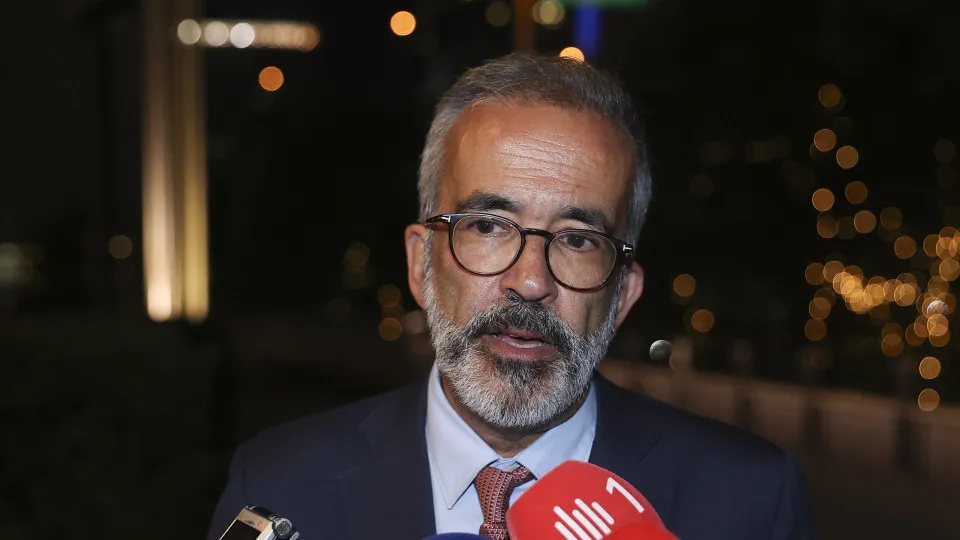

Carlos Condesso voiced concerns over a potential decision regarding newspaper distribution, stating it could negatively impact low-density areas and that the residents there should not be considered second-class citizens.
The mayor of Figueira de Castelo Rodrigo argued that issues such as remoteness should no longer be reasons for making such decisions.
“Nowadays, our territory is no longer as remote as it was decades ago. We have a good road network, highways, and we reach everywhere more quickly because distances are much smaller,” Condesso remarked.
The newly elected president of CIMRBSE highlighted the impact of the removal of tolls on highways A23 (Guarda-Torres Novas) and A25 (Aveiro-Vilar Formoso).
“The elimination of tolls on interior highways has improved access to our region and reduced distribution costs and business context expenses,” he stated.
Condesso emphasized that “Portugal is so small, about 200 kilometers from the interior to the coast, so distance cannot justify measures that only increase inequalities and further penalize the interior.”
He noted, “Information is a crucial tool for literacy and civic and critical education. It is also a constitutional right, so no one can be excluded from this basic right,” he stressed.
The president of CIMRBSE, headquartered in Guarda, warned that the interior “cannot be abandoned.”
He expressed hope that VASP would not proceed with the decision and urged the company to use “common sense” given its dominance in the newspaper and publication distribution market in Portugal.
“There must be a solution and mechanisms that respect competitive issues,” he said, affirming that the 15 municipalities in Beiras and Serra da Estrela are united “to ensure the press reaches every city, town, and street” in this intermunicipal community.
He reiterated, “There is a solution for everything, except death, so I believe that with common sense, a solution will be found.”
The CIM Region Beiras and Serra da Estrela, based in Guarda, comprises 15 municipalities: 12 from the district of Guarda (Almeida, Celorico da Beira, Figueira de Castelo Rodrigo, Fornos de Algodres, Guarda, Gouveia, Manteigas, Meda, Pinhel, Seia, Sabugal, and Trancoso) and three from the district of Castelo Branco (Belmonte, Covilhã, and Fundão).
VASP’s administration announced it is evaluating the need to make adjustments in the daily distribution of newspapers in the districts of Beja, Évora, Portalegre, Castelo Branco, Guarda, Viseu, Vila Real, and Bragança.
In a statement, VASP noted it is currently facing significant financial challenges due to ongoing declines in press sales and a marked increase in operational costs, which exert substantial pressure on the sustainability of the current daily press distribution coverage.
This situation “directly impacts the viability of daily press distribution at sales points, particularly in the country’s interior regions,” VASP — Distribution and Logistics stated.
VASP emphasized that “no definitive decision has been made yet, as this evaluation is ongoing to find alternatives that minimize the impact on publishers, points of sale, and populations.” It expressed “full willingness to continue constructive dialogue with publishers, public entities, and other institutional partners” to find solutions that “ensure access to the press for the Portuguese population and avoid an unprecedented scenario in democracy.”
Lusa contacted one of VASP’s administrators, but no comment on the matter was available at the time.