

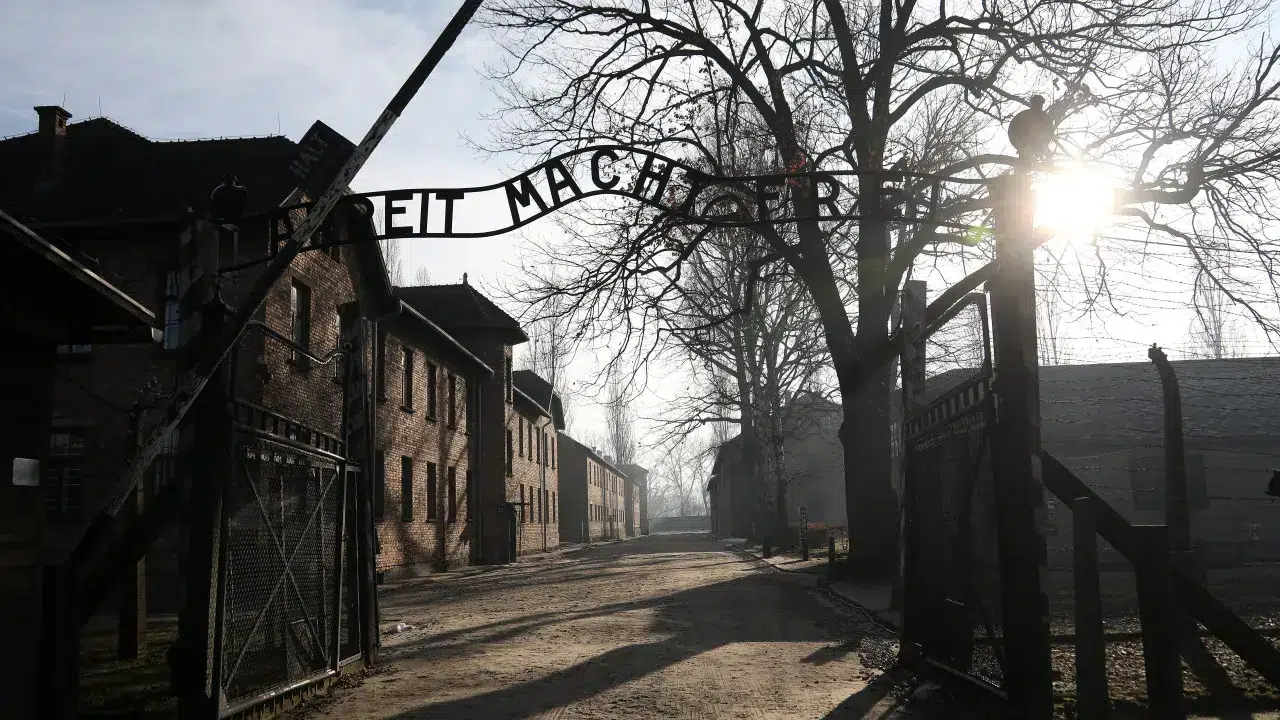
‘The Women’s Orchestra of Auschwitz’ is not a work of fiction about the extermination camp. It is based on documentary research and survivor testimonies. The author, historian and former Reuters journalist Anne Sebba, is generally not in favor of “Holocaust novels.” “There is a lot of documentation, and we need to demonstrate that it was true, that it really happened, that it is not fiction,” she said.
In an interview, the British historian stated that it might be “a perversion to talk about cultural life in Nazi concentration camps” frankly and factually, as her work does, but she emphasized the necessity of telling this story to expose reality.
“‘The Women’s Orchestra of Auschwitz’ exposes the Nazis’ sadism and perversity, and shows how they used any pretext for torture,” the author said, explaining how musical practice was “a double-edged sword,” affecting both the musicians psychologically and the women who had to march to its sound under horrific conditions.
For Sebba, “the story of the women’s orchestra is powerful evidence of the strength that can arise from overcoming differences through small acts of kindness and gestures of solidarity.”
“That was female solidarity at its best, asserting itself as an unyielding force that saved at least 40 lives,” the author expressed.
In the context of World War II and the fight against Nazism, Anne Sebba questions why the Bergen-Belsen camp, liberated by British forces in April 1945, is “so unknown” in her country. The camp was the focus of more than six years of Anne Sebba’s research and was established in 1940, in Lower Saxony.
The historian criticized that in the United Kingdom, the Dunkirk battle, which took place between the end of May and early June 1940, is “better known,” describing it as a “failure turned into a story of courage.”
“But we don’t know about Bergen-Belsen, what the British did, how they liberated it and tried to restore some dignity to the 52,000 prisoners they found there, and bring the Nazi officials to justice. I never understood why this great story wasn’t told.”
The historian feels somehow connected to these events, as her father, who passed away 13 years ago, was a tank brigade commander in the British army that in 1945 destroyed potentially suspicious structures in Belsen. However, Sebba assured she never talked with her father about this subject.
The historian described the situation in that camp as “a horror.” “Thousands of skeletal creatures on bunks, unable to move; corpses piled up throughout the camp, reeking of decay.”
As a historian, Anne Sebba has always been interested in the Holocaust and considers that one cannot be a 20th-century historian without addressing its “greatest calamity.”
Anne Sebba emphasized that, not being a survivor or child of the Holocaust, she believes “there is a story to be told,” particularly about Bergen-Belsen.
“I tried not to write a feminist book, as I think it’s unnecessary. On the other hand, in Auschwitz, women were separated from men, and recent research began to reflect on why women’s experiences were different from men’s, not necessarily worse, though in some aspects they were.”
The historian recounted the separation of mothers from their teenage daughters, who were deprived of maternal care. “Young girls, for example, faced their hormonal cycle alone since mothers were usually sent to the gas chambers.”
“Women weren’t allowed to wear underwear, and their heads were shaved, which is the greatest humiliation for women, and this bleak situation needs to be contextualized with the mindset of the time.”
The research allows the historian to list the main musicians of the women’s orchestra, providing prisoner numbers, nationality, dates of birth and death, the instruments they played, and their repertoire—totaling over “200 works, of which about 12 were marches.”
Composers like Mendelssohn, being Jewish, Chopin, being Polish, and Beethoven, for being “too grand for ‘inferior’ Jewish interpreters,” were forbidden, but some women “defied the Nazi system and played them [in secret], making an effort to reclaim what it meant to be human and maintain the will to live.”
Sebba stated that “the situation experienced in Nazi concentration camps challenges the limits of imagination for horrors. It’s all illogical.”
“It seems illogical for the Nazis to have placed a grand piano in Auschwitz, or to have trained women with men, when inter-sex contact was strictly prohibited. If all of this were fictionalized, no one would believe it, but all of this happened and I can even accept that anyone who reads my book might say ‘this doesn’t make sense.'”
Anne Sebba ensures the “academic rigor” of her narrative with “concrete documentary sources.”
To write ‘The Women’s Orchestra of Auschwitz,’ Anne Sebba conducted interviews with witnesses, particularly survivors who were part of the orchestra, and viewed testimonies preserved by different institutions, aimed at studying the Holocaust and keeping alive the memory of the “greatest calamity” of the 20th century.
“I didn’t want to write a sensationalist story. It’s sad enough to need emphasis with adjectives. It wasn’t necessary. I tried to write in a current manner, even though it’s so hard to believe that what happened did indeed occur.”
“We must learn the lessons of history, whatever they are. Try to prevent them from repeating,” the researcher commented.
When asked if knowledge of history can prevent future mistakes, Anne Sebba stated: “Look at the world now. I have to say no.”
“The only lesson from history is that there are no lessons; there are many variables and very different circumstances, but I would say that one starts to understand, not excuse, but understand how this horrible confusion [World War II] occurred. Maybe we now see it more clearly.”
“I’m amazed that we continue to repeat situations. And we know that war doesn’t solve questions, it just creates more suffering,” Anne Sebba said. “I deeply regret it. We haven’t learned anything to prevent wars.”
Historian Anne Sebba, 73, was a journalist at Reuters news agency, made documentaries for BBC Radio, and is the author, among other works, of a biography of Wallis Simpson and ‘Les Parisiennes: How the Women of Paris Lived, Loved and Died under Nazi Occupation.’
More recently, she wrote ‘Ethel Rosenberg: The Short Life and Great Betrayal of an American Wife and Mother.’
She currently serves as a trustee of the National Archives Trust, UK, in Kew, Surrey, is a member of the Royal Society of Literature, and is a senior researcher at the Institute of Historical Research.