


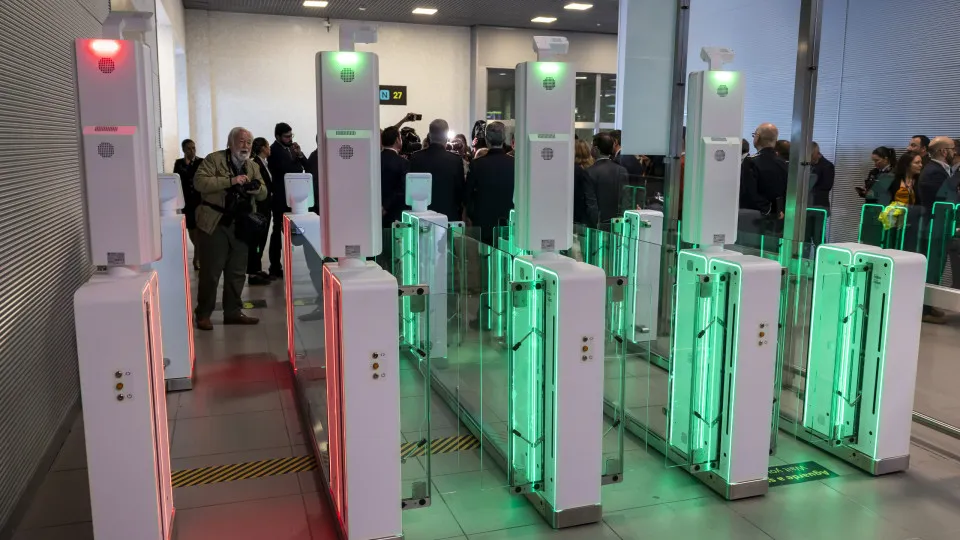
The Internal Security System (SSI) announced a potential suspension of the Entry/Exit System (EES) during the Christmas period, with the decision contingent upon reports received from Portuguese airports.
The European Commission recently authorized this measure due to “constraints observed at several European airports, necessitating additional procedures for EES registration, resulting in increased wait times.”
Nonetheless, the Internal Security System assures that the choice to suspend the EES will be made “on a case-by-case basis if necessary, based on evaluations at each airport, without jeopardizing border security.”
“Should there be no need to suspend the EES, it indicates that there are no excessive wait times at the border,” clarified the organization.
The new European border control system for non-EU citizens was implemented on October 12 in Portugal and other Schengen Area countries.
The system electronically records entries and exits of third-country travelers, detailing the date, time, and border post, replacing traditional passport stamps.
This system’s activation has escalated wait times, especially at Lisbon Airport, with passengers occasionally waiting several hours, prompting the government to establish an emergency task force to address the crisis.
The situation may further deteriorate with the implementation of the second EES phase, scheduled for next Wednesday, which involves collecting biometric data, including photographs and fingerprints.
According to the SSI, the European Commission determined December 10, 2025, as the date when biometric data collection for 10% of passengers crossing Portuguese borders must occur, extending until January 10, 2026.
The EES also requires a travel questionnaire from each passenger. Outside the Schengen Area, the mobile application ‘Travel to Europe’ will allow pre-registration 36 hours before travel, storing data centrally for border control purposes.
In Portugal, the ‘Questionnaire’ functionality will initially be available, according to the Internal Security System.
Reviewing nearly two months of EES operation, the SSI noted no technical constraints upon launch, with “some adjustments made to the PASSE+ system to enhance compatibility with the EES,” and the IT system performed as anticipated, adhering to European regulations.
The SSI mentioned some system stoppages and occasional national issues, which technical teams resolved.
“Overall, the EES is stable, reliable, and robust, meeting the technical requirements for its development,” they emphasized. Since October 12, nearly one million passengers have been recorded in the EES, positioning Portugal as the EU country with the most entries in this new system.