

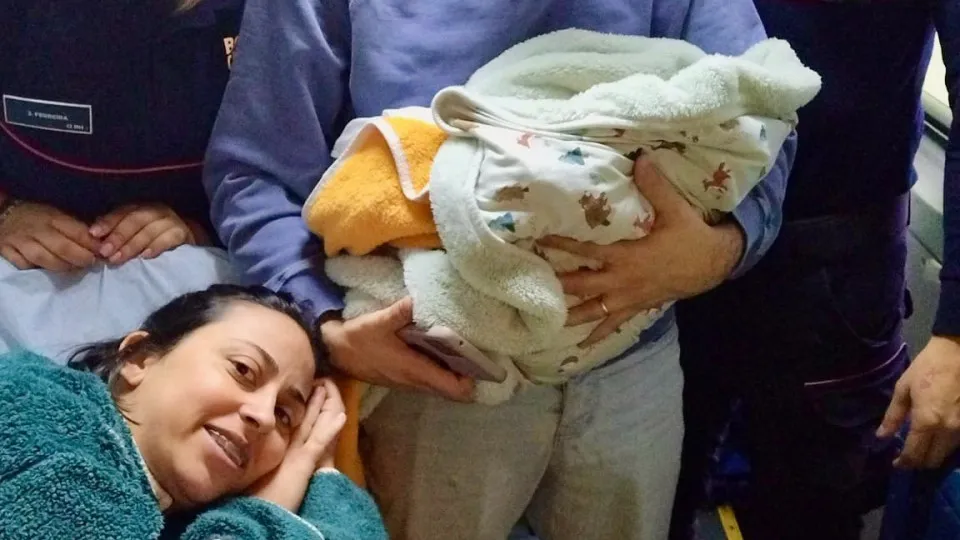
The Cabo Ruivo Volunteer Firefighters in Lisbon assisted in the delivery of a baby born at home on Friday after it “decided not to wait.”
In a statement on Facebook, the firefighters announced that a team was dispatched for a home birth, but upon arrival, the labor progressed swiftly, and the baby was born without waiting for the Medical Emergency and Resuscitation Vehicle (VMER).
The baby was delivered with the support of the Cabo Ruivo Volunteer Firefighters.
According to the statement, “both mother and baby are doing well and were safely transported for hospital evaluation.”
“Congratulations to the family and thanks to our team for their professionalism and dedication to life,” the firefighters stated, welcoming “a new small member” of the community.
Deliveries in Ambulances “Concern” Prime Minister (but Minister Remains)
Prime Minister Luís Montenegro expressed concern in early November over the occurrence of deliveries in ambulances but reaffirmed his complete trust in the Minister of Health.
“Of course, it bothers me a lot that there are deliveries in ambulances or even in public, but I have requested a systematic review to understand why this happens,” he told journalists.
When asked about his confidence in the Minister of Health, Ana Paula Martins, Luís Montenegro affirmed, “Totally, totally, in the Minister of Health and all government members. No government member can be in the government without my complete confidence.”
According to Luís Montenegro, the recent cases of deliveries in ambulances can occur for various reasons, none of which are related to inefficiency or a lack of response capacity in the National Health Service.
“Deliveries in Ambulances Have Always Happened”
National Health Service Executive Director Álvaro Almeida stated in October that “deliveries in ambulances have always happened,” although they seem to be occurring more frequently lately.
“Deliveries in ambulances have always happened. The question now is whether they are happening more or less frequently. It seems they are happening a bit more, and we are analyzing the reasons,” he remarked to journalists.
He added, “We will create regional emergency services, starting with Obstetrics. […] What we are building is a model of regional emergencies that has several components, including the reinforcement of transport services. We are confident with this reinforcement [of transport services].”
Álvaro Almeida noted that while the situation could be minimized, “ambulance deliveries will not cease because they have always existed.”