

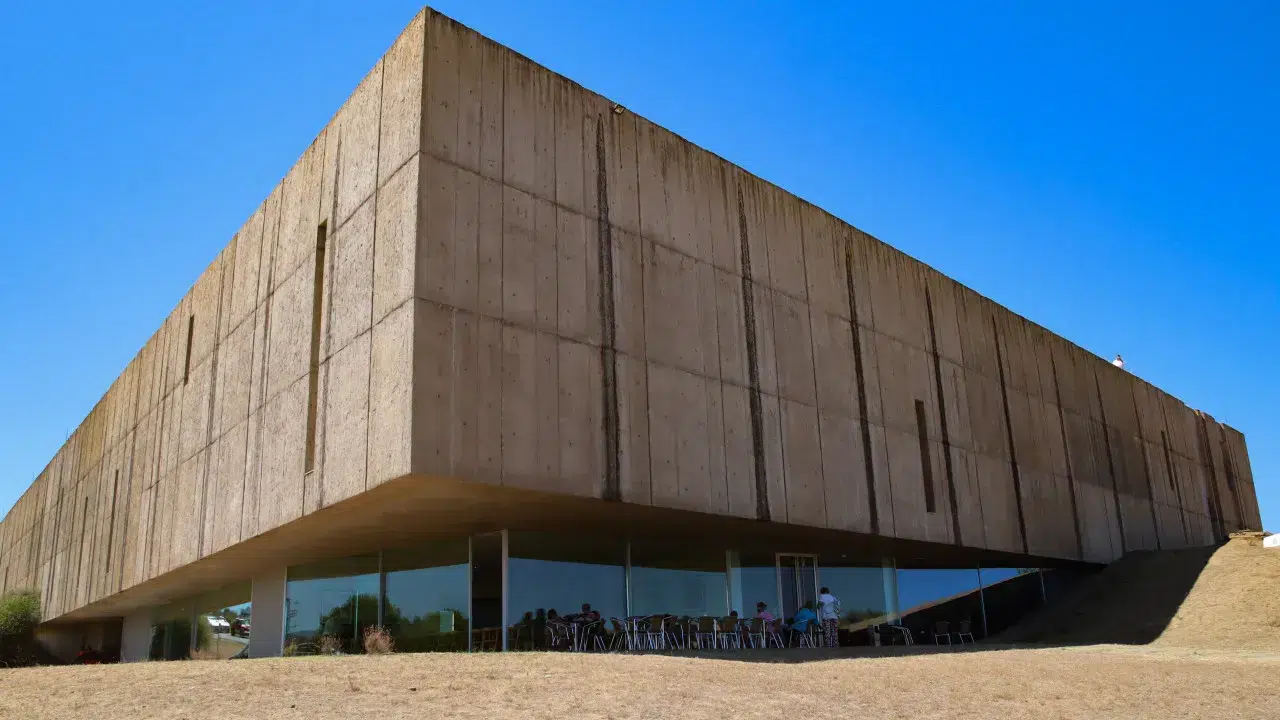
‘Nadir Afonso: Território de Absoluta Liberdade’ and ‘A Marginália de Amadeo’, exhibited in different halls of the museum’s temporary exhibitions, each showcase around fifty works by the “two figures of Portuguese art” and are part of the Portuguese Contemporary Art Network (REPAC) program.
Within the museum’s exhibition program, which continues to blend contemporary expression with the rock art of the Archaeological Park, a project dedicated to Pablo Picasso might later follow these temporary shows, revealed Aida Carvalho, president of the Côa Parque Foundation.
For now, ‘Nadir Afonso: Território de Absoluta Liberdade’ and ‘A Marginália de Amadeo’ “are the museum’s major bets for the upcoming summer,” stated Aida Carvalho, noting that the Nadir Afonso exhibition will run until November 2, while ‘A Marginália de Amadeo’ will be on display until July 27.
The official, who is departing from the presidency of the Board of Directors of the Côa Parque Foundation, also disclosed that she is leaving the scientific and technical curatorship of a major exhibition dedicated to Pablo Picasso prepared for the Côa Museum rooms.
“It will now be up to the next board of directors of the Côa Parque Foundation to decide whether or not they want to hold this exhibition and in what context. The proposal is in place for the museum to host it, through the Picasso Museum [in Barcelona],” emphasized Aida Carvalho.
For the outgoing president of the foundation, who will take her seat as a deputy in the Assembly of the Republic this week, elected by the district of Guarda, hosting exhibitions by contemporary artists like Paula Rego, Graça Morais, João Cutileiro, and now Nadir Afonso and Amadeo Souza Cardoso, in interior territories, represents “a clear sign that all territories are territories of opportunities.”
“Visitors are eager to see these great names” at the Côa Museum, stressed Aida Carvalho, who, in the last four years, has witnessed a 50 percent increase in entries and a revenue boost of over 75 percent. This was aided by ongoing research at the Archaeological Park of the Côa Valley and temporary exhibitions where contemporary art has been dominant.
‘Nadir Afonso: Território de Absoluta Liberdade’ offers a journey through the creative universe of the artist, featuring a collection of original works, many of which – about half of the displayed pieces – are paintings on canvas, according to curator Alexandra Silvano.
“Among them, there is a highlight [a large painting], from the artist’s final phase,” the curator mentioned, adding that “these works are true testimonies of the creative vigor that accompanied him until the end.”
Alexandra Silvano stated that this exhibition reveals not only the aesthetic depth of Nadir Afonso’s work but also the freedom with which he always lived and created: “Loyal to his beliefs and immune to trends or impositions.”
The exhibition is organized into two rooms, spanning from early surrealist works to later periods of organicism and fractal.
“Here we find works from the 1940s, still figurative but already with a clear interest in geometry and cities. The city is not a realistic representation of what we observe; his Cities are mental constructions, visions organized sometimes with geometric simplicity, sometimes with increasing visual complexity,” explained Alexandra Silvano, highlighting Nadir Afonso’s background as an architect and urban planner.
“In Paris, he worked in Le Corbusier’s studio as an architect, while also developing his artistic practice as a painter, engaging with prominent figures like Vasarely, Fernand Léger, Max Ernst, Portinari. In 1965, he decided to abandon architecture definitively to dedicate himself to art.”
Nevertheless, Nadir continued to use the city as a “central and recurring theme throughout his career […], not as an architectural construct, but as painting and expression of an idea.”
Regarding ‘A Marginália de Amadeo’, the exhibition curator, Samuel Silva, explained that it brings together a collection of drawings, sketches found in the artist’s school textbooks, belonging to his family and the library of Casa Manhufe, in Mancelos, Amarante, Porto district.
“We will also have a display of postcards, original letters, some paradigm paintings within this notion of the idea of margin,” stated Samuel Silva.
“This exhibition reveals Amadeo from his intimacy, the uncertainty of the stroke, the theatricalization of doubt. Ultimately, it showcases his expressive restlessness revealed from a young age,” explained the curator.
Samuel Silva believes that “the drawings of Amadeo de Souza Cardoso can create a connection with the Paleolithic engravings of the Côa Valley […], in a fascinating dialogue that will reach the territory.”
Since 2022, the most visited exhibitions at the Côa Museum have been ‘Paula Rego – Rotura e Continuidade’ (60,000 people), ‘Dark Safari’, from the State’s Contemporary Art Collection (38,000), and ‘Mapas da Terra e do Tempo’, by Graça Morais (37,000 people).