
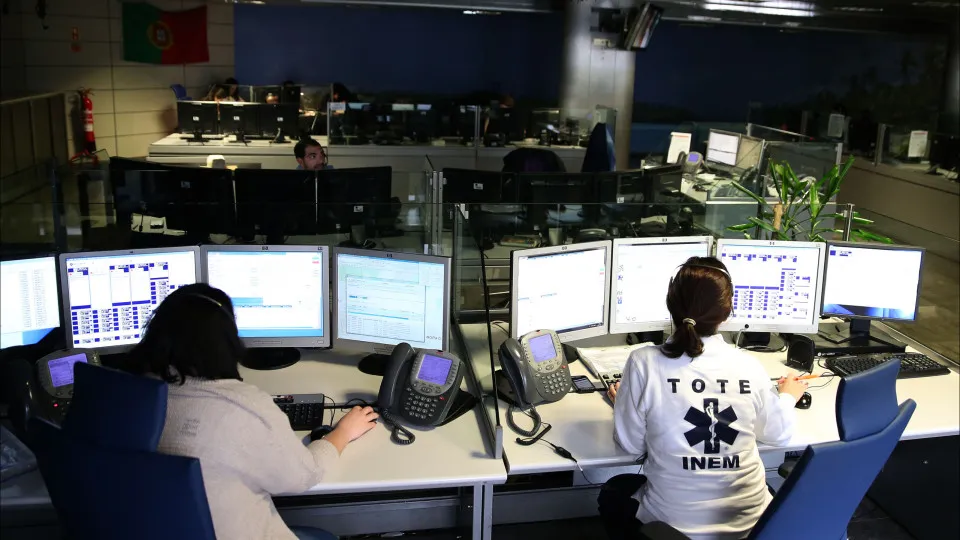
The proposal for the restructuring of the National Institute of Medical Emergency (INEM), submitted to the Ministry of Health, advocates for emergency calls made to 112 and the SNS24 Health Line (808242424) to be handled by a unified central service.
In comments to Público, Leonor Furtado, president of the CTI, explained that this unified center aims to achieve “efficiency and safety gains,” as it would enable a “faster and more immediate” response due to the physical proximity of the various human resources responsible for medical assistance.
There could be more than one number, but having a centralized hub would make it “easier to activate and allocate resources, instead of transferring the call to another line,” said Leonor Furtado.
The unified line is expected to have three regional hubs in Lisbon, Porto, and Coimbra, staffed by trained operators who are to receive 150 to 200 hours of theoretical and practical training. These operators would conduct the initial call triage and activate resources.
The center should be coordinated by a physician “with autonomy in the final destination and resource referral decisions,” supported by internists or emergency specialists and nurses who can provide patient advice, support in clinical triage and resource activation, and communicate clinical data to destination hospitals.
The establishment of the “unified service line” is projected for a rollout within three years.
With a common medical coordination, integration with SNS24 will allow for immediate consultation scheduling, the newspaper notes, highlighting that approximately “40% of calls waiting for the CODU and about 6% of calls received are transferred to the SNS24 Line.”
The proposed changes also suggest that the most specialized resources “should be allocated” to local health units (ULS), “with shared resources and career benefits,” and opening non-emergency transportation to private operators, currently handled by firefighters and the Red Cross.
The commission’s analysis confirmed significant issues previously identified by audits conducted by the General Inspectorate of Finance and the General Inspectorate of Health Activities.
The INEM suffers from “command, control, and audit deficiencies,” with “functionally obsolete” IT systems, insufficient training, and “great asymmetry in response times and resource allocation” nationwide, it stresses.
The CTI believes that the majority of the budget—”over 50%”—allocated to the primary partners of the integrated medical emergency system (SIEM)—fire departments and the Portuguese Red Cross, although distributed differently—”hinders the search for partners and alternative models for pre-hospital emergency medical services.”
Moreover, the “strategic, operational, and resource management and internal control systems do not ensure the proper management of public funds and other assets.”