
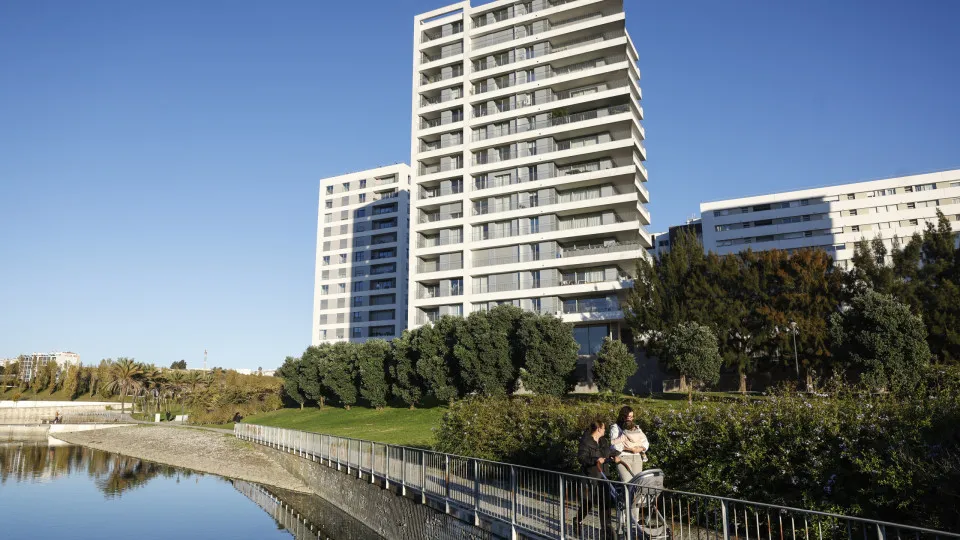
Construction is the constant backdrop in the area officially known as Alto do Lumiar, one of the few places left for expansion in Lisbon.
Located in the northernmost part of the municipality, surrounded by the 2nd Ring Road, the airport, and the North-South Axis, the formerly rural area, which once contained only noble estates, now features condos with apartments priced up to one million euros.
In what was the first major public-private partnership between the Lisbon City Council and the Society for the Management of Alta de Lisboa, the space retains a grand scale, with wide sidewalks providing breathing space among buildings.
Covering 300 hectares, Alta de Lisboa, shared by the districts of Lumiar and Santa Clara, was designed to accommodate 20,000 more people on top of the approximately 40,000 residents already living there, with new construction aimed at meeting this demand for private market sales.
Initially, the focus was on eradicating degraded neighborhoods (such as Musgueira, Quinta Grande, and Cruz Vermelha, among others) and rehousing their populations.
Gebalis, the manager of the 12 municipal housing clusters in Alta de Lisboa, is currently investing over 3.3 million euros to rehabilitate around 20 buildings.
In some neighborhoods, recently renovated buildings stand out, yet others remain worn by years of neglect.
Three decades after the approval of the “pioneering and visionary” Alto do Lumiar Urbanization Plan (PUAL), Mikaella Andrade, director of local intervention at Gebalis, praises the social class mix resulting from the cohabitation between private and municipal housing.
“People coexist and share experiences and neighborhood networks, showing no signs of segregation in terms of class or socioeconomic status,” Andrade notes, highlighting the uniformity of the constructed environment.
Architect Manuel Abílio Ferreira concurs: “The city was thoughtfully designed (…) and it shows for the better.”
Architecturally, “there was a certain effort to homogenize the materials,” and the municipal houses “are very similar in design” to other buildings, he remarks.
However, perspectives vary. The area includes many PER projects—Special Housing Programs designated numerically from 1 to 12 under Gebalis management—as well as numerous condos.
José Almeida, president of the Alto do Lumiar Residents Association (ARAL), emphasizes a “mix attempt,” noting that the integration between “the two realities” is still evolving.
The municipal homes face “serious issues,” and “the area lacks planned amenities,” lacking an auditorium, a cultural space, a “decent” library, and a completed sports complex.
In practice, the residents of 3,200 municipal homes there “do not have the same conditions,” especially as they lack options for alternatives.
“Those with economic means can make those choices. So, these are completely distinct realities,” Almeida separates.
Nuno Barbosa, president of the Quinta Grande Neighborhood Association, agrees: “We mix with other PER residents but have little to no interaction with those from private sales (…). Maybe at clubs, like football, there’s some mix, but, for instance, at school, those from private sales don’t attend Pintor [Almada Negreiros] or D. José [I], they go to other schools, the blending isn’t there.”
A resident “from the start” in PER7—locally known as Quinta Grande—the cultural animator does not foresee “anything positive” from construction anticipating more newcomers to Alta de Lisboa.
“As it stands in the country, newcomers are unlikely to arrive with an openness to integrate with others. (…) For those not living in social housing, this area is a dormitory, just somewhere to sleep,” he laments.
In PER7, a playground is missing, for example. “Construction is not geared toward the population; it targets future occupants. (…) A new park could emerge, a place for the two realities to converge, but no (…), buildings are rising, more buildings,” Barbosa criticizes.
The balance between PER and private market sales was once “far more uneven,” and today “coexistence flows peacefully,” states architect Manuel Abílio, a 17-year resident in one of the first Alta condos.
“It’s not a situation of oil and water,” he clarifies, acknowledging, however, that ongoing construction may present new challenges, as private market prices are “very high, with a T2 easily reaching 450, 500, 550 thousand euros,” introducing “a new demographic layer.”
“We are in a transition phase, so to speak, between a normal, even very healthy, coexistence between PER and private market residents, if that distinction can be made, and this new layer of apartment residents at considerably higher prices,” Abílio situates, waiting to see how new residents will relate to the broader community, such as whether their children will attend the same schools all other Alta de Lisboa children have attended.
A few hours in the area is enough to hear reports of the poor state of municipal housing interiors.
The ongoing Gebalis intervention focuses on facades, replacing windows and roofs to enhance building insulation and energy efficiency.
“It’s a very important intervention” for “people’s well-being,” but “it’s not enough,” as “there are severe issues, (…) some unresolved for over 10 years, with people (…) having homes in deplorable conditions, full of mold,” details ARAL vice-president João Tito Basto, based on daily complaints received at the association-managed “Neighborhood Desk.”
According to Mikaella Andrade of Gebalis, there are “some areas needing more consistent work” and some PER projects “are not yet at 100%,” particularly accessibility-wise. There are roundabouts without full exits and neighborhoods with only one way in and out.
“It’s a long process, not something done overnight,” she emphasizes.
Meanwhile, the contract with the Society for the Management of Alta de Lisboa was canceled after Lisbon’s municipal assembly rejected its renewal this past March.
In a statement, Lisbon City Council acknowledges “promoting public housing on plots with predominantly residential designation” and ensures that the “future decision” on municipal land will “always be framed by the Alto do Lumiar Urbanization Plan [PUAL].”
Mayor Carlos Moedas’ administration highlights that “it’s still not possible to accurately assess the full impact of the decision” to suspend the contract, “currently under evaluation,” already noting “various direct and indirect impacts, including financial ones,” necessitating halts on ongoing works and project suspensions.