

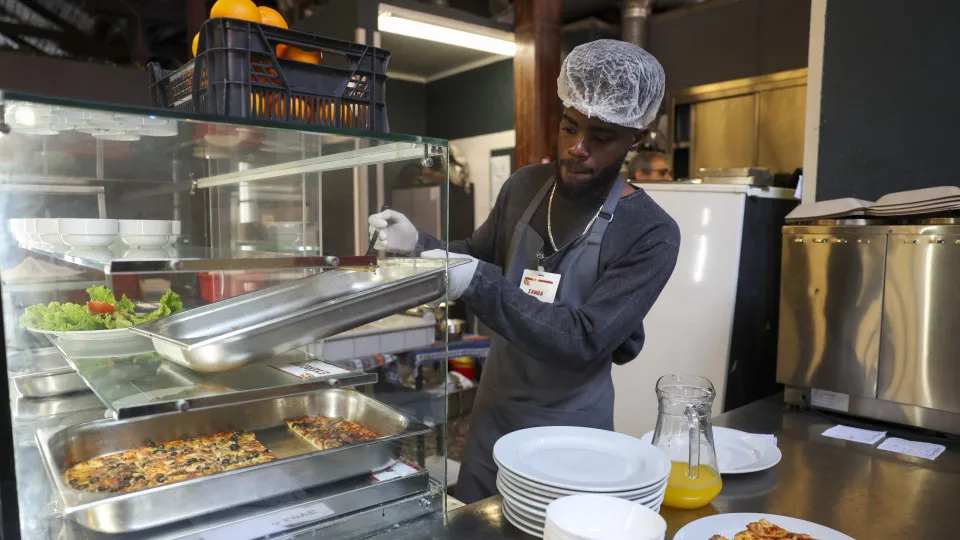
The space resembles a restaurant open to the public, but no bill is presented at the end of the meal. Customers are free to leave a donation that directly benefits those who prepare and serve the pizza, who are participants in the “Pizz´and Love” project at the Salvation Army Housing and Reintegration Center in Beato.
“Someone can come here and leave 50 cents, but there are people who, knowing the purpose of Pizz’ and Love, leave 50 euros for a pizza,” says João Barros, director of the Housing and Reintegration Center.
For each contribution, three euros typically cover operational costs, while the remainder goes to those in the kitchen preparing pizzas and serving at tables.
In the old warehouse, now transformed into a restaurant operating once a week, 52-year-old Hélia Feijão serves pizzas and ensures customer satisfaction. She has been through various hostels and an extended hospital stay before arriving at the Salvation Army.
“I was homeless, hospitalized for three months with a lung problem, and came directly from Curry Cabral Hospital to here. They welcomed me here with a lot of care,” she shares.
She has been at the center for eight months, attending a baking and pastry course provided by the Institute for Employment and Vocational Training (IEFP). When she finishes, she plans to pursue the trade and create her own business: “If I can, I’ll open a little corner for myself.”
Hélia previously worked as a room attendant in some of Lisbon’s well-known hotels. Her lung problem prevents her from handling intensive workloads and long hours.
Her dreams also involve having a house. “It’s a bit complicated, but I’ll succeed,” she smiles, confident in the support she has received. “They help a lot, searching for housing, employment, everything a bit.”
The room fills up at lunchtime. From the kitchen come the pizzas that 59-year-old Luís Cardoso prepares “with a lot of love.” That is why, he says, the delicacy comes out of the oven with that “smell” and appearance.
Luís worked as a security guard until life’s circumstances led him to seek help.
“I had never done this before, but look, it’s quite exciting!” he exclaimed, while discussing the new experience. Soon, he will have to leave the temporary shelter and lacks “a second plan,” but he admits that the future may involve pizzas.
“Who knows, one day, I might get a part-time or even a full-time job; it’s something different from what I used to do, but it’s quite fun, and I like it a lot,” he confesses.
The kitchen team rotates. Guided by a service chief (cook), users who accept to participate receive training. However, according to João Barros, the most important recipe is the connection created with the community.
“The most important thing here is not just the pizza itself because there are many places in Lisbon with pizzas and very good ones. We are not here in a competitive pizza-making mindset,” emphasizes the director.
“At the same time, we include the entire community outside the institution to be part of this life-changing process,” he adds.
For João Barros, more important than the pizza is who made it and where it’s eaten.
Of the 75 people living at this center, between 20 and 25 participate in “Pizz´and Love” and other workshops held during the week at the Salvation Army social center’s Academy, ranging from woodworking to candle production, also sold on-site.
Among the regular clients of “Pizz´and Love” is the team of artist Bordalo II, with a studio in the area.
“On Thursdays, it’s always the place we come for lunch,” attests Ricardo Almeida, who does “a bit of everything” in the artist’s production team, sharing the table with other members of the group.
Natacha Serrão, an employee of the Beato Parish Council, located just a few meters away, also marks “mandatory presence” on Thursdays with her colleagues.
“I’ve been here a short time; they recommended coming here for lunch one day, I tried it, and I loved the concept, the food, and the space itself,” she mentions.
The Salvation Army social center, a charitable institution, operates in partnership with the Lisbon City Council, Social Security, and the IEFP, in an area that houses 80% of Lisbon’s homeless population, recalls João Barros.
The accommodation center opened in 1997 in preparation for Expo 98, in the eastern zone of Lisbon, where other shelter structures exist.
Beato, he points out, is a parish of contrasts, where there is “a lot of poverty,” but also large companies and a tech hub. “Sometimes a millionaire comes in to eat a pizza made by a homeless person,” he observes.
“What differentiates this project is opening the center’s doors to the community, our space here in Xabregas. People passing by think this space is a restaurant and ask, come in,” adds Santiago Carreño, Salvation Army chaplain.
“What we want is for this not to be a closed place that constrains people. We have to change the way of thinking; we are working to reintegrate these people into society,” he concludes.
The Salvation Army was founded in London in 1865 and has been present in Portugal since 1971.