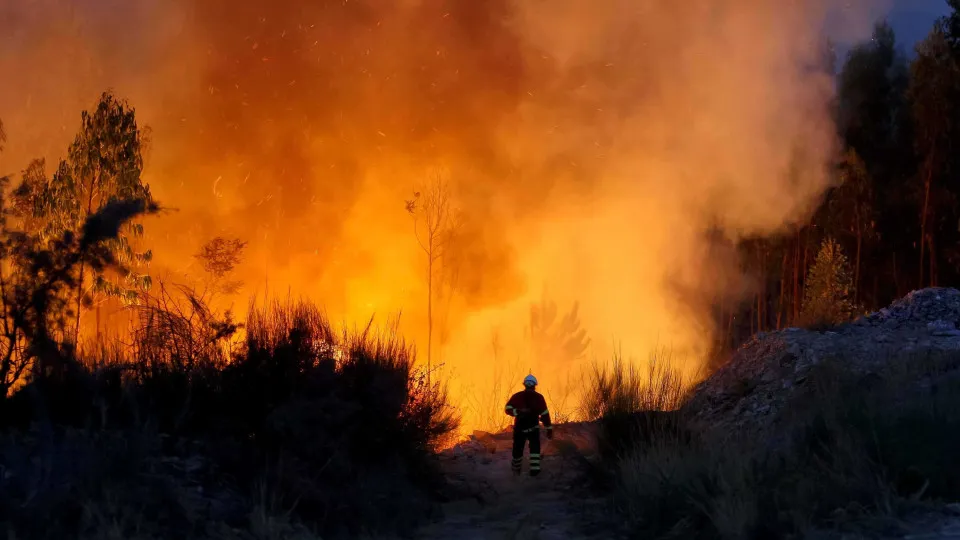
According to the AGIF – Agência para a Gestão Integrada de Fogos Rurais, by the end of November, this year marks the “fourth worst year since 2001 in terms of burnt area,” with 270,000 hectares consumed in 8,284 fires, predominantly affecting the North and Center regions.
The number of fires remains significantly below the historical average, as noted in a preliminary analysis. Following the burnt area in the tragic 2017, with 537,131 hectares, the flames ravaged more land in descending order of magnitude in 2003, 2005, and 2025.
The 8th Provisional Report on Rural Fires by the Instituto de Conservação da Natureza e Florestas (ICNF) notes that between January 1 and October 15, this year recorded “the fourth lowest number of fires and the second highest burnt area since 2015.”
The analysis from the Integrated Rural Fire Management System (SGIFR) highlights that this year, “44 fires with over 500 hectares burnt occurred: 21 in the North, 17 in the Center, five in the Alentejo, and one in the Algarve,” accounting for only 0.5% of the total number of fires but 91% of the total burnt area.
The largest rural fires in August included the blaze starting on August 13 in Piódão, Arganil municipality, in the Coimbra district, which spread to the Guarda and Castelo Branco districts, devastating 65,417 hectares over 11 days.
The previous weekend saw a fire in Freches, Trancoso, Guarda district, destroying 46,906 hectares, and another that started on August 13 in Ferreira de Aves, Sátão, Viseu district, consuming 13,761 hectares.
Regarding causality, although 23% of fires remain under investigation, the SIGFR reveals that 34% were due to arson, 11% with inconclusive investigations, 9% from burning for pasture renewal, 9% by agroforestry machinery, 5% due to natural-lightning, and 5% related to transport and communication causes.
When analyzed by district, Porto recorded the most fires (1,921), followed by Braga (804) and Viana do Castelo (642), though mostly minor (less than one hectare burnt). However, the most affected in terms of burnt area was Guarda, with 83,790 hectares (31% of the total burnt area), followed by Viseu, with 42,183 hectares (16%), and Castelo Branco, with 39,313 hectares (15%).
AGIF reports that the affected area is mainly composed of brushland, pastures, and sparse vegetation (52%), followed by forests (38%) and agricultural areas (10%). Of the burnt forests, 56% were in maritime pine and other coniferous areas, 23% in cork oak, holm oak, and other broadleaves, and 19% in eucalyptus groves.
The majority of the burnt area occurred in Priority Prevention and Safety Areas (APPS), with 84% in areas of “high” or “very high” danger, covering 33% of the rural territory, a fifth in Forest Intervention Zones (ZIF), and 34,000 hectares (4% of the total area) within the National Network of Protected Areas.
This year, four individuals (a firefighter, a sapper, a former mayor, and a machine operator) died, with investigations continuing into the deaths of two other civilians due to burns or accidents. Over a dozen primary residences were destroyed, prompting the Government to rapidly approve support following criticism from mayors and civil society for initially failing to address concerning situations in affected regions.
Images of flames and the desperation of populations forced to contend with fires threatening agricultural and residential areas without adequate resources filled television programs repeatedly.
Criticism of coordination failures in firefighting efforts was voiced, prompting the executive to propose the ‘Forest 2050, Greener Future’ plan to parliament, which includes 61 short-term actions by 2025, and 88 medium-term initiatives between 2028 and 2050.
Additionally, legislators approved a proposal by the PS for the creation of an Independent Technical Commission to analyze the summer fires, comprising 12 distinguished experts tasked with producing a report with conclusions and recommendations.