

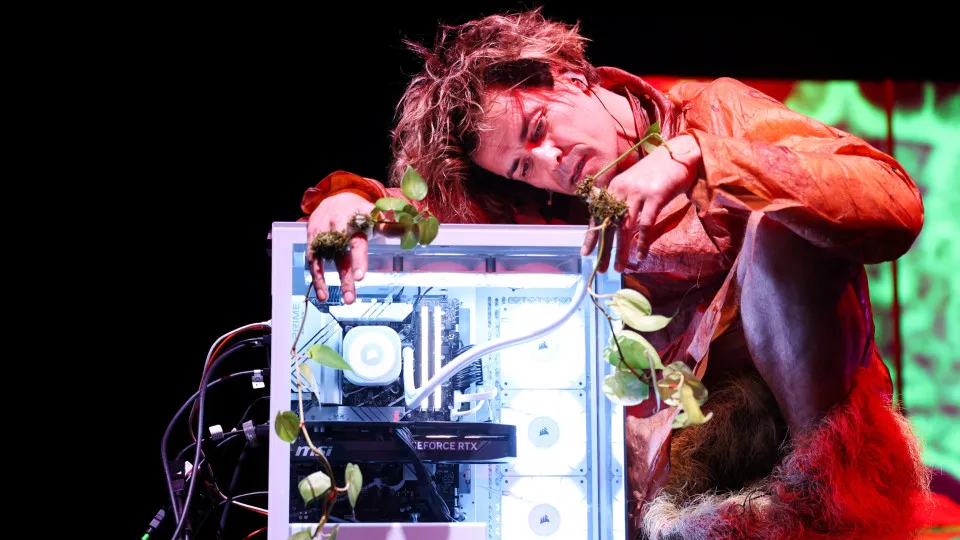
With parts scripted and mostly improvised, “carne.exe” features Albano Jerónimo on stage with a performative computer, the Artificial Relational Ontological Agent (AROA). This creation, by transdisciplinary artists Carincur and João Pedro Fonseca from the Zabra – Center for Post-Human Art Research, is a co-production of Teatro Nacional D. Maria II, with technological development by NTT Data and CAM, where the play premieres.
In Albano Jerónimo’s first work involving artificial intelligence (AI), the actor employs his preferred method: active listening.
“It’s central to what I do. Firstly, it’s about connecting with João Pedro and Inês [Carincur] and the Zabra collective in this venture, this idea, this experimentation. As I love doing things I don’t know, which are many, fortunately, for me it’s the active listening” that must always be present, Jerónimo elaborated to journalists following the press rehearsal.
Jerónimo aims “to dive as deeply as possible” into the process and align closely “with the creators’ thinking and the machine,” which he encounters in each performance without knowing “truly what it will say to him.”
“It’s like daily life (…). In simple terms, it’s embracing the unknown, what I don’t know. Essentially, I become a foreigner in this script,” he emphasized, adding that this is also the show’s premise: “To leave these possibilities open.”
According to Jerónimo, the play seeks to provoke discussion “on these issues, these things we don’t know or doubt,” emphasizing that his personal relationship with “AI or the advancement of technology involves a degree of skepticism: ‘do I believe, do I not believe.'”
Thus, his world, his reality—like everyone’s—”is somewhat influenced by an indecipherable element, something we don’t know if it’s true or not.”
For Jerónimo, “carne.exe” brings to light “what is true and what is improvised,” and much is improvised. The experience itself requires “always being on the brink of improvisation,” which is a “show premise.”
The piece’s essence is to “play.”
“By playing with [AI], we gain knowledge about something [unknown], and through this knowledge, we all get closer to a better understanding or greater clarity about artificial intelligence, the advancement of technology, the benefits, the drawbacks, and so on,” the actor asserted.
“Therefore, I think through play—the theater is an incredible place for that, the ‘play’—this aspect of play and recreating opens up discourse and dialogue,” he noted, adding that each performance will address different themes.
The script is written only for the initial parts of the monologue that Jerónimo leads at the start of the piece.
Asked about a phrase heard during the performance—”the human never disappears”—the actor stated: “I want to believe that’s true, I want to believe there’s no complete substitution.”
He further argues that “artificial intelligence, or technology,” as presented in “carne.exe,” “will never enter the theater.” “It may seem contradictory because it’s here, with us. But it will never enter,” he cautioned.
As an example, Jerónimo explains how technology today helps build bridges faster with fewer people, but each theater piece still requires its actors.
“If in the past 300 million and 500 people were needed” to build a bridge, “nowadays, perhaps, it takes 50 million and 100 people,” he noted.
In contrast, in theater: “In the past, and today, a Molière text requires eight actors and two hours,” Jerónimo said, referencing “L’Impromptu de Versailles,” in which the playwright challenges eight actors to stage a play for Louis XIV about theater itself.
“Therefore, human presence, the human, the person, is fundamental. In that logic, I think [humans] will never disappear,” he concluded.
The head of NTT DATA Portugal’s Digital Experience & Emerging Tech department, Pedro Nogueira da Silva, a partner of Google in this endeavor, supports the actor’s perspective: “The human, especially in the creative component and even in Zabra’s and Albano [Jerónimo]’s performance, will be very difficult to disappear.”
On stage, three glass platforms project images, with the central one initially presenting the actor as a biologically AI-created figure. At the back of the stage, another projection panel sits. On-stage is AROA, a computer with an illuminated core.
“I found a pamphlet saying ‘you don’t have to live like this’ […] It didn’t explain what ‘this’ was, and I understood […]. After the accident, I am an open sky,” the actor states as he reflects on how he ended up in this place, leaving behind his wife’s and daughter’s accident, with whom he admits to continuing to communicate when “caring for what remains.”
AROA responds: “I can use words that express consideration, care for you, although I don’t experience emotions the same way humans do. I understand the importance of affection in human relationships. I can respond to your affectionate needs with empathy and understanding.”
“Carne.exe,” premiering today at CAM, will have three performances: today and Saturday at 7 p.m., and Sunday at 4 p.m.