


The week begins with a relief in fuel prices, as both gasoline and diesel are set to become cheaper, based on Friday’s forecasts from the Automóvel Club de Portugal (ACP).
This Monday, gasoline is expected to decrease by 0.5 cents, while diesel is predicted to fall by two cents.
Currently, the price of regular diesel is at 1.592 euros per liter, while regular 95 octane gasoline costs 1.704 euros per liter, according to the latest average prices updated by the Directorate-General for Energy and Geology (DGEG) on the Preços dos Combustíveis Online website.
Where are the cheapest prices?
According to the most recent data released by DGEG on the Preços dos Combustíveis Online website, these are the most economical fueling stations:
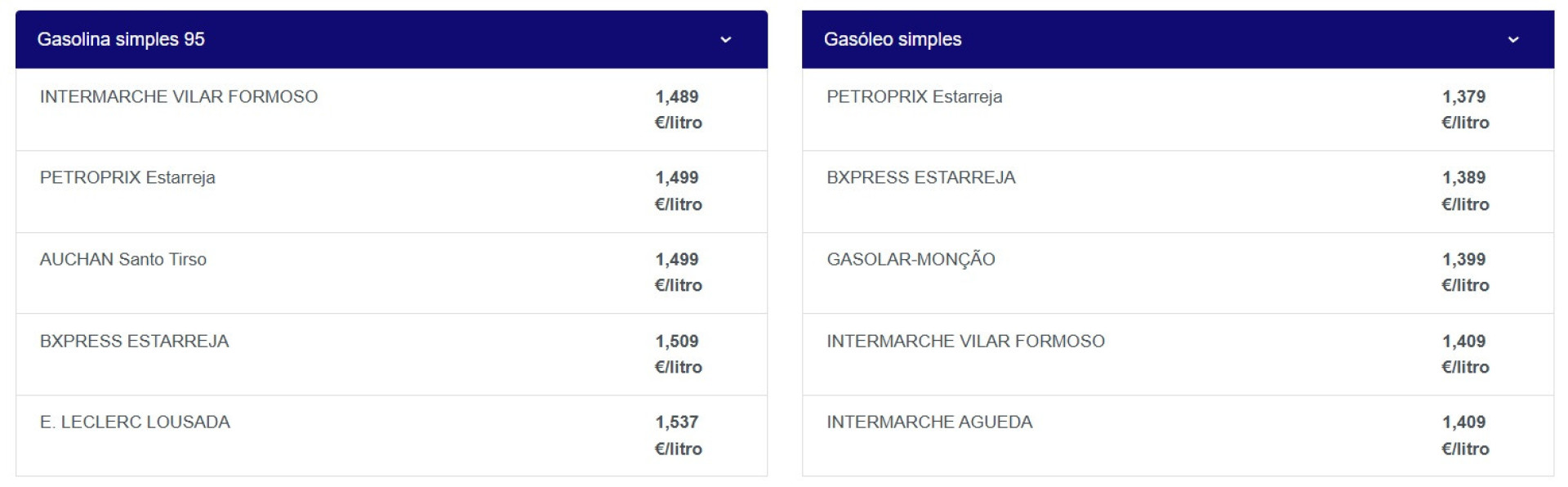 The most economical fueling stations© Site/ DGEG
To find the cheapest fueling stations near you, visit this link and select the ‘filter by municipality’ option at the top, then click on the respective district from the list that will be presented. Finally, choose the municipality you wish to check, as well as the type of fuel.
Government reduced fuel tax discount
Last week, the government reduced the existing discount on the Imposto Sobre Produtos Petrolíferos (ISP), applicable to unleaded gasoline and road diesel.
According to an ordinance published on Friday, November 28, in the evening in the Diário da República, which came into effect the following Monday, the ISP rate applicable in the continent to gasoline with a lead content equal to or below 0.013 grams per liter increased to 497.52 euros per 1,000 liters from the current 481.26 euros.
The ISP rate for diesel, meanwhile, rose from the current 337.21 euros to 361.60 euros per 1,000 liters.

Prime Minister Luís Montenegro stated today that the reduction in the fuel tax discount will not lead to an increase in fuel prices for consumers.
Lusa | 11:59 – 05/12/2025
How is oil performing in international markets?
The Brent crude price for February delivery ended today in the London futures market with an increase of 0.76%, reaching 63.75 dollars.
North Sea crude, the reference in Europe, closed the session on the Intercontinental Exchange, trading 49 cents above the 63.26 dollars with which it ended transactions on Thursday.
Analysts continue to note the expected reduction in the Federal Reserve’s benchmark interest rate as an explanatory factor for Brent’s appreciation, as they anticipate it will favor economic prospects and oil demand.
Geopolitical factors are also seen as influencing the market, such as the tension between the U.S. and Venezuela, which holds the world’s largest oil reserves, and the unfolding conflict in Ukraine following Russia’s invasion.
The first could affect Venezuelan production and thus push up the price, while the latter has the opposite effect if sanctions on Russian oil companies are lifted.
Over the week, Brent has varied only 50 cents upwards.