

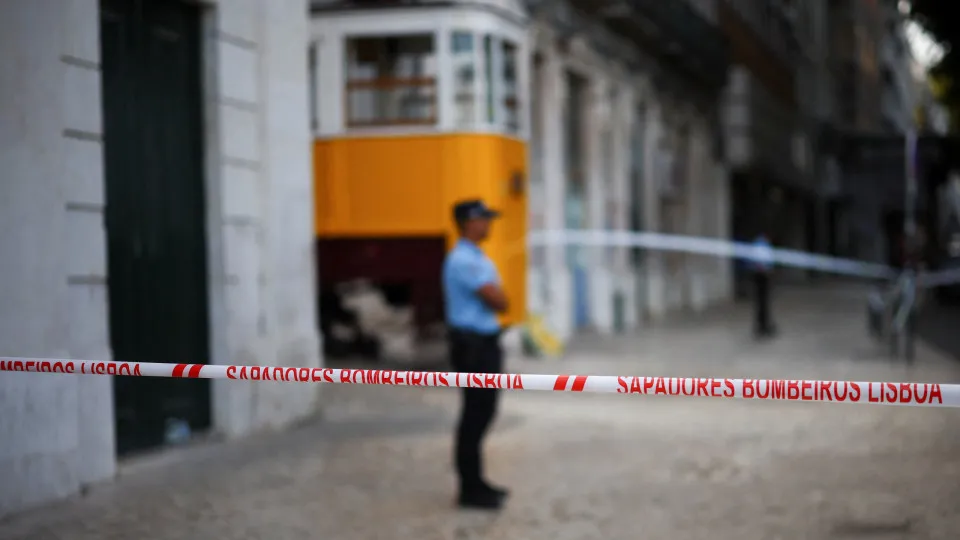
“Lisbon is in mourning and it’s a tragic moment for our city,” stated the Mayor, Carlos Moedas (PSD), at the accident site.
In the 140-year history, this has been the worst accident involving the Glória funicular, which connects Praça dos Restauradores to Jardim de São Pedro de Alcântara, covering a distance of 276 meters with a steep gradient.
Classified as a National Monument, this elevator was highly popular among tourists, transporting about “three million passengers per year,” according to the Lisbon City Council, the sole shareholder of Carris, the municipal company responsible for managing this public transportation equipment.
In light of the tragedy, which received international attention, the government declared a day of national mourning while the local authority declared three days of municipal mourning.
While aid was extended to the 22 injured, most of whom were foreign tourists, the 16 fatalities were honored: eight men and eight women, aged between 36 and 82 years, and of Portuguese (five), British (three), South Korean (two), Canadian (two), Swiss (one), French (one), Ukrainian (one), and American (one) nationalities.
The safety of such equipment was called into question, and besides the inoperation of the Glória elevator, the activity of the Bica and Lavra funiculars, as well as the Graça funicular, were “immediately” suspended for technical inspections. Three months later, inspections are still ongoing, according to the Lisbon City Council, and “after the completion of technical reports, the schedule” for resuming operations will be defined.
Representing Carris employees, union leader Manuel Leal of Fectrans and STRUP reported “repeated complaints” about the maintenance of the elevators, including the Glória, linking the problems to the outsourcing of this service, contracted to MNTC – Technical Engineering Services.
However, Carlos Moedas assured that he “never” received any warning and stated that “there is no mistake here that can be attributed to a decision by the Mayor”, considering resigning would be “cowardice,” but he promised to do so if anyone proved the accident resulted from his actions, particularly concerning Carris.
After participating in a cabinet meeting, invited by the government, the mayor called a municipal executive meeting for September 8, during which several measures were approved, ranging from the creation of a support fund for the victims to the development of a new technological system to ensure the elevators’ safety, which is still ongoing.
The support process for the victims and their families is being assured by Fidelidade, an insurance company that told Lusa it is still “premature to identify a total value” for the allocation of support, including compensations.
The accident happened a month before municipal elections, with Carlos Moedas running for re-election as Mayor of Lisbon. Political parties demanded a prompt accountability determination. The President of the Republic, Marcelo Rebelo de Sousa, stated that “the judgment on the political responsibility” of Moedas was “up to the voters”.
On October 12, the social democrat was re-elected by the PSD/CDS-PP/IL coalition, with 41.69% of the votes, even improving his 2021 result (34.25%), defeating the socialist Alexandra Leitão (PS/Livre/BE/PAN), who secured 33.95%.
Several entities are investigating the accident, including the Public Ministry, with the criminal police, and the Office for the Prevention and Investigation of Aircraft and Railway Accidents, which in October revealed that the connecting cable of the two cabins of the Glória elevator, which failed, did not meet specifications or was certified for passenger transport.
Following these findings, the Carris administration, led by Pedro de Brito Bogas, resigned. Recently, Moedas appointed Rui Lopo, the current administrator at Transportes Metropolitanos de Lisboa, to lead the future administration of Carris.