

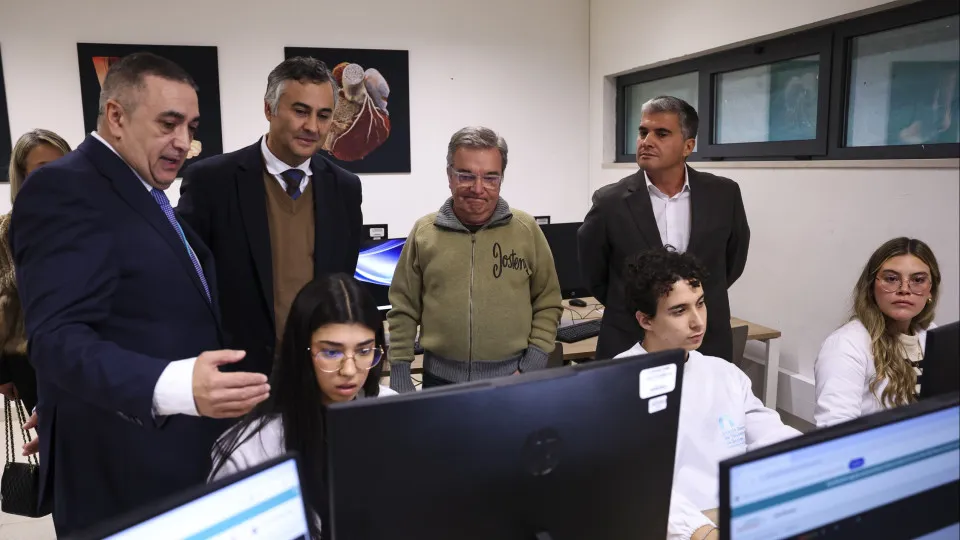
“We will now correct the overtime hours since 2018, and the correction amounts to 30 million euros that should have been paid to teachers and were not,” Fernando Alexandre stated to journalists following the inauguration of the INNOV2CARE laboratories at the Escola Superior de Tecnologia da Saúde de Coimbra.
The official added that the administration would pay more than 20 million euros this year in overtime hours.
The Minister of Education, Science, and Innovation explained that the existence of unfilled schedules in Portuguese schools does not necessarily mean students are without classes.
“Having an unfilled schedule does not mean, in most cases, that students are without classes. Many unfilled schedules are being occupied and ensuring classes through overtime hours,” he clarified.
Fernando Alexandre mentioned that the ministry is developing an information system, though not yet available, “to know which students are without classes, in which subjects, and for how long.”
The official expressed regret that public schools are consistently disparaged publicly and noted, “It is unfair for directors, who make a huge effort to ensure classes for all students, to confuse unfilled schedules with students without classes.”
Regarding today’s public sector strike, the Minister of Education mentioned that eight percent of schools closed, while the general strike on Thursday resulted in half of the national schools closing.
In his remarks to journalists, Fernando Alexandre stated that the Government has a proposal for non-teaching staff that will be discussed with the new leadership of the National Association of Portuguese Municipalities, which is set to be elected this weekend.
“In January, we will negotiate this. We have just received the study we commissioned on the decentralization of education, which accounts for costs and ratios of non-teaching staff,” he mentioned.
The Escola Superior de Tecnologia da Saúde do Politécnico de Coimbra (ESTeSC-IPC) inaugurated the INNOV2CARE laboratories this afternoon. These facilities, related to the courses of Medical Imaging and Radiotherapy and Clinical Physiology, are equipped with state-of-the-art simulators and ultrasound devices, representing an investment exceeding 600 thousand euros, funded by the Recovery and Resilience Plan (PRR).
Among the new equipment are advanced ultrasound simulation tools, advanced simulators for computed tomography, magnetic resonance, conventional radiology, fluoroscopy-guided procedures, PET, and SPECT-CT, and an advanced medical image processing system with virtual reality, making the establishment the first national higher education institution to offer cutting-edge technology to its students.
The INNOV2CARE project involves a consortium of eight higher education institutions — the University of Coimbra (project leader), Polytechnic Institute of Coimbra, University of Beira Interior, University of the Azores, Coimbra Nursing School, Polytechnic Institute of Castelo Branco, Polytechnic Institute of Guarda, and Polytechnic Institute of Viseu — aiming to readjust education and learning in health areas.