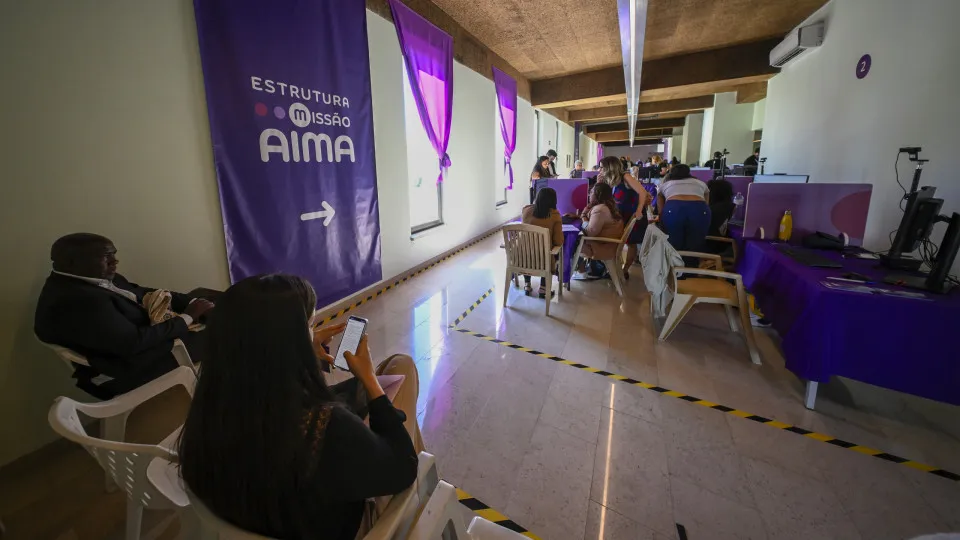



An alarming report has emerged from Venteira’s Parish Council President, João Pica, who revealed that on his first day in office, he was approached with an offer to falsely attest to a residence for a payment of 60 to 70 euros, right outside the council’s premises.
“Someone approached me, asking if I could serve as a witness for a residence certificate. I paused, and the individual suddenly said, ‘Don’t worry, I’ll pay you 60 or 70 euros,'” Pica disclosed.
Pica discovered ongoing negotiations at the council’s entrance in Amadora, involving witness recruitment from Venteira residents, who were offered money to falsely confirm addresses provided by immigrants for residence certification.
These immigrants often reside in non-residential spaces like shops, which cannot be listed on a certificate required for a residency permit.
Before the Agency for Integration, Migration, and Asylum mandated additional documentation a year ago, the payment for these witnesses could reach 200 euros.
In some instances, payments were made inside the council, much to the dismay of staff who would then escort the facilitators and participants outside upon discovery.
Participants who accept money in exchange for false testimony often do not know if the address in question is genuinely occupied by the immigrant needing the certificate.
The real homeowners, whose addresses are used illicitly — reportedly hundreds in Venteira alone, and many more throughout the county — often confront the council when they learn of this misuse.
“I’ve had four or five meetings with local residents questioning how we could be issuing residence certificates for their addresses when they themselves don’t live there. I was shocked, to say the least, and realized it must be related to this parallel business,” Pica explained.
A report was lodged with authorities about a year ago without consequence, and Pica disclosed that a new complaint is being prepared for the Public Prosecutor’s Office on this and other irregularities involving immigrants.
Pica pointed out the core issue: the ability for a person to repeatedly serve as a witness. “After five or six years, where we’ve seen this system fail and damage service credibility, I believe legislation should impose limits,” he asserted.
He emphasized the situation where individuals could testify over 50 times, leading to instances like one particular home on Avenida de Pangim listed as the residence for over 100 people within a short period.
Pica argued that the parish’s only means to verify declarations would be to investigate onsite whether the immigrant truly resides at the indicated address.
“We lack resources. At one point, we issued an average of 30 to 40 certificates a day. How can we verify all these residents? We simply don’t have the capability. We are, supposedly, left to trust what they tell us,” he stated.
Pica acknowledged that most council employees recognize that in 80% of cases, the people in question do not reside at the provided addresses.
A Venteira resident, who requested anonymity for security reasons, reported learning her home’s address was being misused when she received a Via Verde letter featuring non-resident names.
Among the names was Mohamed, which raised her suspicions about potential fraud relating to residence certificates, as she was aware of similar incidents involving South Asians.
She contacted Brisa and subsequently Venteira’s Parish Council to ensure her address would not be used without her consent for any further registrations.
The resident fears her address might be exploited for other purposes and regrets that after 30 years in the county, she no longer feels the safety she sought when purchasing her home.
She opted against filing a police report, citing past experiences where she received no response to previous complaints.
She is aware of other property owners in Amadora experiencing similar issues with their addresses being improperly used by immigrants and harbors hope that the council’s reforms might diminish such illegal activities.
Pica recounted the case of a resident living with her husband facing serious issues, supposedly housing five individuals she learned of only when someone knocked on her door looking for one of them.
“We have a case with our executive board secretary facing a serious issue as well. He resides in Borel, Venteira, and police visited to inquire about a supposed resident he doesn’t actually have,” Pica shared.
“When things are smooth, authorities don’t act. But when any immigrant, or anyone else, engages in any illegality, where do authorities go? To the registered residence. They knock, and who do they find? The owners, but not the supposed residents, since they don’t actually live there.”
In his first month leading the council, Pica has identified “many dozens” of affected residents, but staff estimate hundreds.
To counteract the issue, the council now requires a lease registered with tax authorities and an original residence proof, restricting witness testimony to one person. If trustworthy, they may attest multiple times.
“This move effectively removed traffickers from our premises. They realized they could testify only once, so they no longer congregate here,” Pica reported.