
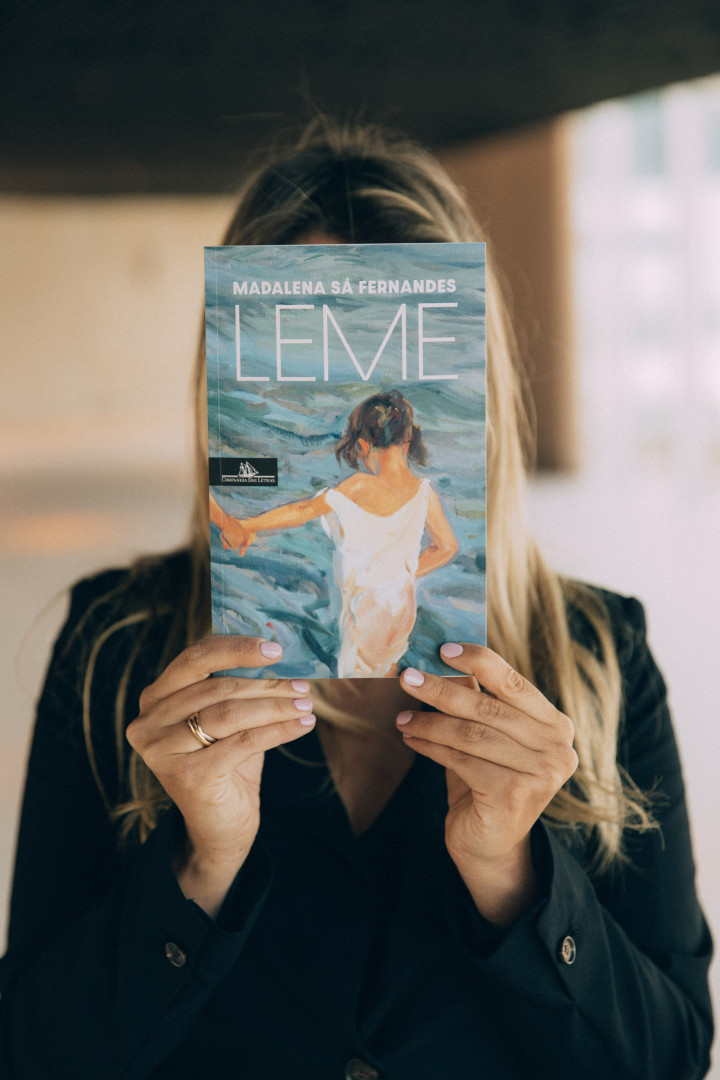
Madalena Sá Fernandes grew up surrounded by books, making the decision to become a writer a natural one. She studied Languages, Literatures, and Cultures and was in the process of starting her first novel when the pains of her childhood and youth intercepted her words. Madalena released ‘Leme’ in 2023, an autofiction portraying a “raw story of a toxic relationship” and showcasing “the pillars of resilience of a child subjugated to the dark power of her stepfather.” The child in question was Madalena herself. The book unfolds the story of a young girl who witnessed domestic violence firsthand, leaving scars.
The significant success of ‘Leme’ (also the name of a neighborhood in Rio de Janeiro, where the author lived) reached Brazil in 2025, prompting the author to travel across the Atlantic, where she experienced “one of the best weeks of her life.”
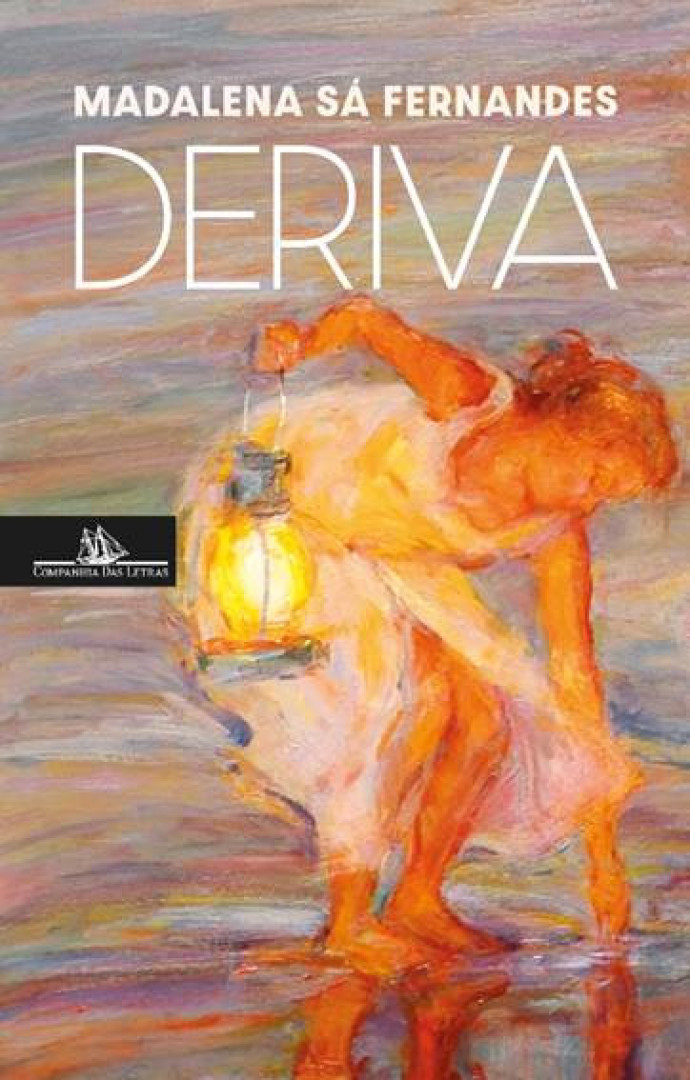
In 2024, ‘Deriva’ emerged, a compilation of the columns the author writes for Público.
We spoke with the author, who discussed her professional journey, shared reflections on the scourge of domestic violence, and revealed future plans.
There was an urgency to write about that [domestic violence] as if it were a catharsis, a purge, to name that suffering, to put it into words.
How did your passion for books and literature begin?
Everyone in my family reads a lot, both my mother and my father. My mother is a voracious reader. All the people closest to me are avid readers.
I grew up surrounded by books, and I think that greatly contributed to my interest. School played a crucial role as well, especially in Portuguese classes, which I loved, and they were also fundamental in developing this passion.
When did you realize that you wanted to make literature your life?
I’ve always known that writing brought me the most pleasure. Since I learned to write, I knew it was what I loved to do, though I didn’t realize at the time that it could be a viable profession. I’ve always known my passion lies in writing. It was only when I realized that people actually dedicated themselves to it that it became a very old dream.
When you graduated in Languages, Literatures, and Cultures, what were your professional expectations?
I still had no clear expectations; I wanted to pursue my passion and extend the joy I felt in my Portuguese classes, delve deeper into literature and the works I was passionate about. I wanted to deepen my knowledge of those authors. I already knew that what I truly wanted was to write, but I also believe that writing requires extensive reading, and so I was in the course with the aim of reading and learning as much as possible.
I was very afraid before publishing it. Of the consequences, of how people would react, and it generated some anxiety
Your first book, ‘Leme’, was published in 2023. How was that process? Because you initially aimed to write a different kind of book.
I was going to write fiction, a novel entirely different from ‘Leme’. But the story in ‘Leme’, which is about my childhood and adolescence, ended up taking precedence over the other project I had.
How did you realize that it was about your story you wanted to write?
As I was writing the other book, the main character of ‘Leme’, depicted as the figure of the stepfather, began to appear in the form of other characters in the other book. I realized there was an urgency to write about that. I wrote what I felt and what made sense, almost as if it were a catharsis, a purge, naming that suffering, putting it into words.
At the same time, this writing took on a strong literary inclination. I wanted it to be literature; that was fundamental for me.
Was there any apprehension that crossed your mind? After all, it was your story but also your family’s.
I was very afraid before publishing it. Of the consequences, of how people would react, and it generated some anxiety, perhaps even more anxiety than fear. But it quickly dissipated once it was published, and I was very happy with that.
Did the writing process bring you a lot of suffering? Did you remember everything the book recounts?
The images described are those most present in my memory, but it is also an autofiction. It involves a lot of literary work on the images. The process was more liberating than it was distressing.
I didn’t aim to create a manifesto, but I also find it interesting to extend a hand to other women who go through such situations [domestic violence]
Did you ever consider the impact of writing a book about your life? The fact of giving several interviews and having to talk about painful episodes repeatedly?
I hadn’t thought about it, but it is happening, and it doesn’t bother me. The subject is somewhat settled. It’s never fully healed, but talking about it doesn’t trigger any specific type of suffering. On the contrary, it even brings solace; I’ve found considerable comfort and support.
You mentioned in an interview that your aim with this book wasn’t to become an activist on the issue of domestic violence.
My goal was to write a book. To create a literary object, but it ended up having additional impact due to its subject matter. Honestly, I find that very important and beautiful. I didn’t aim to create a manifesto, but I also find it interesting to extend a hand to other women who go through such situations.
Brazil is part of my emotional geography and my story. Closing a cycle by going there to launch the book is moving
How do you react when someone approaches you and shares their life story related to domestic violence?
I’m saddened that it’s still such a prevalent issue. It’s an epidemic, both in this country and, for instance, in Brazil, as well as worldwide. At the same time, I’m grateful for people’s willingness to share, the fact that they feel comfortable sharing with me. Although I’m not a therapist, I recommend therapy precisely to help deal with it. I’m pleased that my book touches people in that sense.
The domestic violence numbers in Portugal are very high. What do you think society should do to protect women, in a way?
Punishing or blaming women in this aspect isn’t beneficial; it’s important to continue denouncing abusers, speaking out as much as possible. Spreading awareness about the importance of denouncing while also offering alternatives, as often those in such situations, especially in lower social classes, feel there are none. Fortunately, many excellent associations promote this. What’s lacking is something on a larger scale, providing psychological support for victims and even offenders.
There needs to be a serious societal discussion about this issue and everything that perpetuates this view of violence against women’s bodies, minds, and desires. It’s now extending to the youth through so-called ‘influencers’ and people who propagate these misogynistic and macho discourses. It’s very concerning, and there must be a substantial alert in society across various fields to ensure this discourse doesn’t persist.
‘Leme’ has been a great success since its launch, allowing you to release it in Brazil, a country special to you and your story.
‘Leme’ is also set to be released in more countries, but I confess Brazil was the one that made me happiest. It’s part of my emotional geography and my story; it was a significant country for me and the book’s narrative. Leme is also a neighborhood in Rio de Janeiro. Closing a cycle by going there to launch the book is moving. It’s gratifying to see the book go beyond borders, and I’m very happy about that. It will also be released in Argentina and Denmark this year.
In 2024, you released your second book, a collection of columns titled ‘Deriva’. What do you enjoy writing more?
Writing columns is part of my routine; it’s almost automatic now. It’s essential for me as well; it helps me ponder the world, gain new perspectives, and have a voice that can be more humorous or focus on smaller or seemingly irrelevant things. But literature, writing a book, is always a more painful, profound, intense, and transformative process.. It’s what I want to do with my life.
Columns allow me to take a break from that more demanding writing.
Your next book is also an autofiction. What can you reveal about it?
It will have an aspect of autofiction, but it’s also a book that’s challenging to define. I can’t categorize it. It will therefore challenge forms, but for me, that’s not as relevant. It will include a bit of autofiction, a bit of an essay; it’s going to be a mix.
Did your mother support you a lot in writing this book?
During the phase of publishing ‘Leme’, her support was crucial because it lifted a significant weight off my shoulders, and I felt that if I had her support, it was made. It was wonderful to feel that.
A few months ago, you experienced a less happy event [the writer João Pedro George made sexist comments about you]. How did you deal with that?
It was what I wrote at the time, and for me, that matter is now resolved.
Care must be taken so that the speed of the networks does not impose on the sacred space of slowness in literature
What do you want for your professional future?
I am pursuing a master’s degree and would like to continue to a Ph.D. I want to write various things, including a play, a children’s book, a fiction novel. I have no shortage of ideas. I will continue with the columns. Anything related to writing interests me.
Today’s world sees a lot of literary promotion on social media, particularly on TikTok. How do you, as a writer of this generation, view that?
It has been very beneficial for my books and books in general. And I think it’s about being in the time we live in. But there’s the flip side, which is maintaining a balance between constantly being on social media, which have supersonic speed, and the fact that writing and reading do not align with that pace. Writing and reading require slowness, constituting spaces of slowness.
Care must be taken so that the speed of the networks does not impose on the sacred space of slowness in literature. It’s great that books are discussed in these mediums, but they should serve to catapult into this other space of slowness and not let one devour the other.