

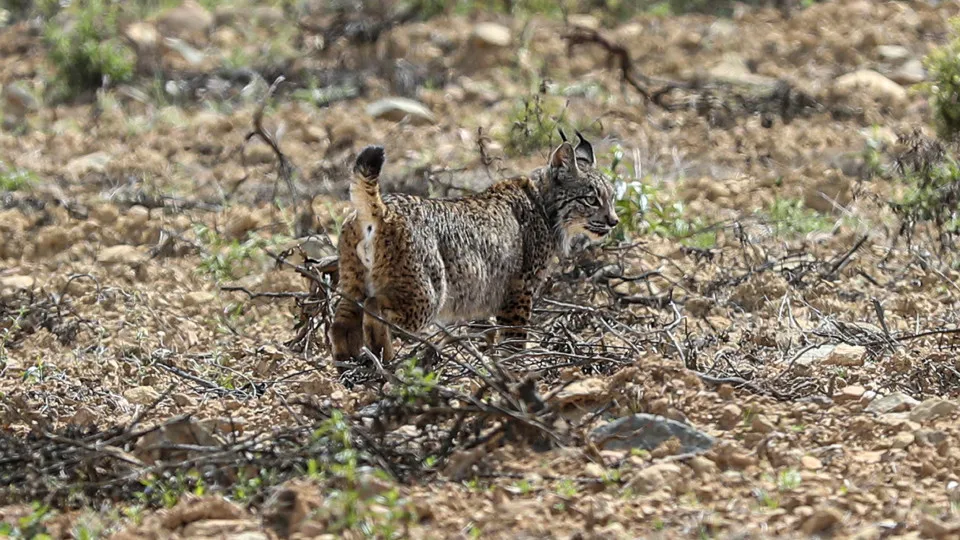
The Institute for the Conservation of Nature and Forests (ICNF) announced that 35 Iberian lynxes were captured between September 29 and December 9 in the Vale do Guadiana area, in the municipalities of Serpa and Mértola.
This campaign aims to “gather precise health information” and assess “the condition of the lynx population living freely in Portugal,” the ICNF stated.
“Each captured specimen is identified, photographed, examined, vaccinated, and biological and genotyping samples are collected. Whenever possible, the animal is fitted with a tracking collar,” the statement added.
The collar “helps detect early signs of physical problems,” enabling the “monitoring of behaviors and movements that allow mapping real risks in the field” and identifying “more dangerous road segments, where the speed of vehicles and the natural curiosity of the lynxes create a lethal combination, a threat that can only be tackled with accurate data and prompt action,” the ICNF noted.
In this campaign, across the eight explored areas, nine of the 35 captured animals were “still juveniles,” and 22 individuals were fitted with tracking collars.
At the end of the operations, which involved technicians, nature wardens, and forest agents, the animals were released back into their natural habitat.
According to the ICNF, the number of captured animals set a “record” since these efforts began in 2018.
This was the final campaign as part of the LIFE Lynxconnect project, a joint initiative between Spain and Portugal, which has been reshaping the species’ survival map.
The project for the recovery and conservation of the Iberian lynx initially involved breeding animals in captivity, with the first being released into the wild in 2011.
The latest Iberian Lynx Census in 2024 recorded that the species exceeded 2,400 specimens, with 2,401 lynxes counted between Spain (2,047) and Portugal (354), of which 1,557 are adults or subadults, and 844 are cubs born in the wild.
In 2024, the species’ status was upgraded from “Endangered” to “Vulnerable” on the Red List of Threatened Species.
“This recovery is one of the best examples of conservation actions for threatened species worldwide, thanks to the continued efforts of public administrations, interested sectoral entities, private estate owners and managers, the general society, and the European Union through the LIFE program,” the institute stated.