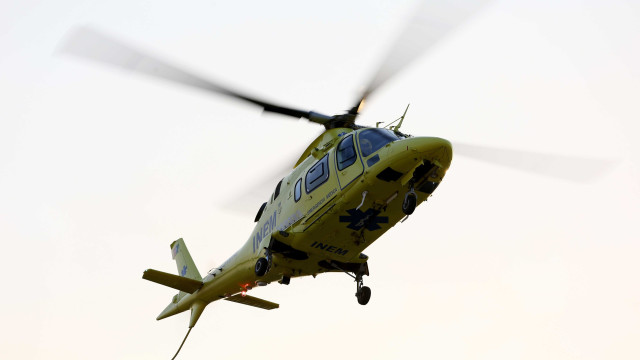


The National Institute of Medical Emergency (INEM) announced today that the helicopter operated by Gulf Med Aviation Services (GMAS) is currently non-operational due to a technical failure identified by the operator.
Despite the helicopter’s unavailability, the INEM medical team assigned to this base remains fully operational, ensuring the continuity of specialized clinical response through a VMER unit, the institute assures.
INEM mentions that the helicopter is recent and within its manufacturer’s warranty period, emphasizing that “the manufacturer is solely responsible for the necessary intervention and repairs.”
INEM, which is “continuously monitoring the situation,” has demanded GMAS take immediate steps to restore operational capability as swiftly as possible.
GMAS, in a separate statement, confirmed the issue, attributing it to an unexpected technical problem with the aircraft that prevents its use.
The company assures that the helicopter, an Airbus H145, had less than a hundred flying hours upon entering service, explaining that the resolution of the technical issue “can only be performed by the manufacturer, as the aircraft remains under the manufacturing warranty.”
Regretting the entire situation, which it claims is “beyond its intervention capacity,” GMAS states that it is “making every effort to ensure the manufacturer acts as soon as possible.”
The Loulé emergency medical helicopter is one of four that began full operations on November 1, functioning 24 hours a day after a four-month delay.
Besides the Loulé aircraft, the new emergency helitransport contract awarded to the Maltese company GMAS includes emergency helicopters at the Macedo de Cavaleiros, Viseu, and Évora bases, ensuring 24/7 air coverage.
The contract was awarded to GMAS at the end of March, but only in October did the service begin being provided 24 hours a day, albeit partially, with the aircraft from Macedo de Cavaleiros, Évora, and Loulé.
In the statement released today, INEM notes it will “apply the contractual penalties and continue to monitor contract compliance while working with the operator to ensure full restoration of air emergency capacity, guaranteeing the necessary response to citizens under all circumstances.”
The international public tender awarded the service to the Maltese company GMAS for about 77 million euros, anticipating the operation of the four helicopters on July 1, which did not occur.
Consequently, INEM proceeded with a direct adjustment with the same company to prevent disruption in urgent medical transport, though the Court of Auditors refused to approve this contract.
GMAS has considered taking legal action against the Portuguese state, denying accusations from the Court of Auditors, which claimed the company acted in bad faith in the process with INEM.
The international public tender was launched in November 2024, and the contract with GMAS was announced in March, anticipating the operation of four helicopters at INEM bases in Macedo de Cavaleiros, Viseu, Évora, and Loulé until 2030.
Emergency medical air transport was being provided by the Maltese company in an operation supplemented by the Portuguese Air Force, which INEM had to resort to in July due to a lack of aircraft.
The new emergency medical helicopters make it possible “to conduct inter-hospital transport missions of newborns with safety and clinical stability,” as they have the capacity to carry incubators.