
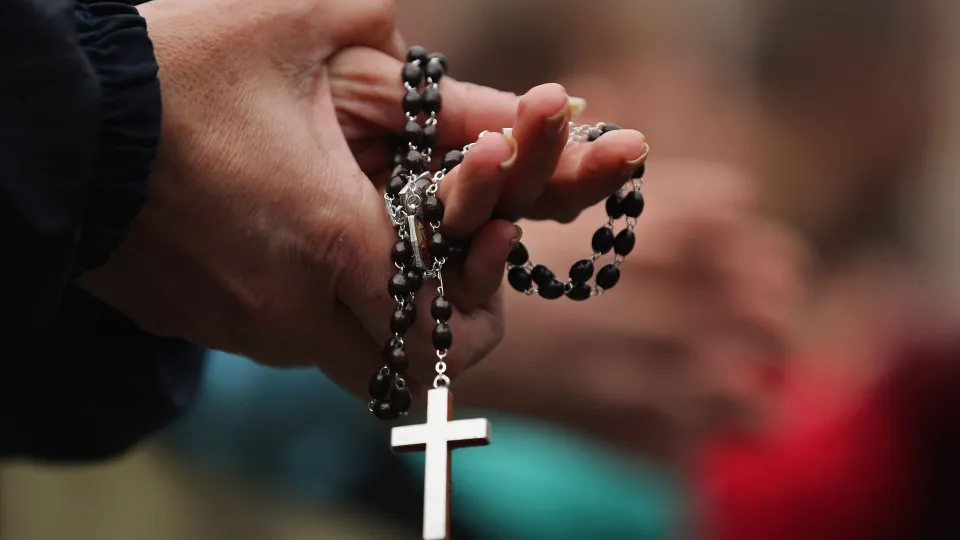
Catholics Paulo Rangel (PSD) and José Manuel Pureza (BE) exemplify two distinct perspectives on defending the Church’s Social Doctrine. Rangel emphasizes continuity in discourse, while Pureza applauds what he describes as a “more clearly condemnatory” stance on capitalism and the dehumanization of the poor, especially immigrants.
Days before his first apostolic journey to Turkey and Lebanon, set to begin Thursday, Leo XIV urged American bishops to condemn violence against immigrants in the U.S.
Such public positions have been criticized by several far-right movements, which accuse the Church of shifting progressively to the left.
“In fact, there’s great constancy in the doctrine,” remarked Paulo Rangel, also a professor at the Catholic University and current Foreign Minister. He noted, “There will always be groups looking to claim, appropriate, and dictate the line that should be followed by the Vatican.”
University professor José Manuel Pureza disagrees, arguing that under Pope Francis, the Church adopted a “much more clearly condemnatory discourse” against liberal capitalism and the aggressiveness of a racist, xenophobic far-right, specifically against poor immigrants.
“The focus of hegemonic political discourse has clearly shifted to the right,” and the Church’s message “clashes with that,” particularly amid the “aggressiveness against the poorest, immigrants, and racialized individuals,” Pureza stated.
Rangel pointed to the Church’s “constant discourse,” recalling that Leo XIII, who inspired the current Pope’s name, condemned “wild capitalism and liberalism,” as well as “Marxism-Leninism and the complete rejection of the vision held by Marx, Engels, and their followers.”
Then, during the Second Vatican Council in the 1960s, the hierarchy defined its “place in the political sphere” and the social obligations of Catholics, encapsulating all principles of the Church’s Social Doctrine.
“That social doctrine, I believe, isn’t even what is causing tension between progressives and conservatives, especially among those extremely on either side,” said Rangel, noting that the division stems from “moral or often liturgical doctrine” issues.
Accordingly, the Pope’s stance on immigrants is not a critique of public policies but rather a condemnation of violence against individuals and a defense of the “humane treatment of all human beings, an indisputable tenet of the Church’s doctrine and any humanist,” Rangel argued.
In economic terms, the Church has remained equidistant, Rangel maintained, noting that John Paul II condemned capitalism in the 1980s while allied with Reagan and Thatcher against “communist dictatorship,” something that “irritated them greatly.”
John Paul II “never ceased condemning communism while also condemning capitalism in its wild form,” said Rangel, emphasizing that “contrary to what is believed, the doctrine is very constant” post-Vatican II Council, though “each Pope has their style.”
Pureza challenges the notion of a great divide between Marxism and Catholicism, saying: “This economy kills, says Francis, referring to capitalism.”
“Pope Francis said in 2014 that forces must unite to prevent the dehumanization of our societies.”
The current “aggressive neoliberalism” demands a “firm defense of positions” from Catholic thought because the “social doctrine has also been adapting to the changed reality,” Pureza said, noting that many bishops and priests have incorporated the Papal discourse in their practice.
“I’m not deluded: Despite this shift towards a focus on the poor and disadvantaged in the Church’s discourse,” Pureza remarked, many bishops, clergy, and laypeople still hold positions quite distant from what Pope Francis introduced into Church language and thought.
Pureza issued a challenge to Catholics: “The Church must risk being seen as revolutionary or as a critic of established powers to remain true to its original mission,” suggesting that a Church avoiding risks “serves no purpose.”
Considering the “magnitude and complexity” of current issues linked to “increasing social and economic aggressiveness leaning to the right, and the deterioration of our common home due to predatory capitalism impacting resources and climate,” a Church that fails to “assume a strong voice” is “unfaithful to Jesus’s command to Peter,” regarded as the first Pope.