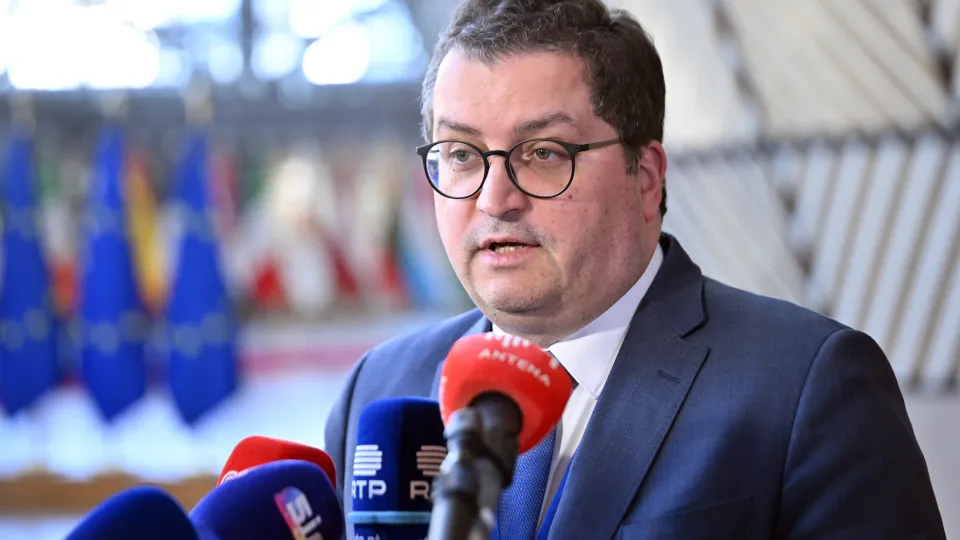
Finance Minister Joaquim Miranda Sarmento acknowledged on Friday that a national minimum wage (SMN) of 1,600 euros is an ambition but declined to set a timeline for reaching this goal.
When questioned regarding the Prime Minister’s statements about increasing the minimum wage to 1,600 euros, from its current level of 870 euros, the Finance Minister refrained from specifying a timeline.
“It would be speculative” to predict when this might happen as “it depends on many variables. We must have ambition, ambition to reform the country, increase productivity, and achieve more economic growth,” he emphasized, speaking to Portuguese journalists in Brussels following the European Union finance ministers’ meeting.
However, according to Joaquim Miranda Sarmento, “the target [of a 1,600 euros minimum wage] is what is outlined in the electoral program.”
Montenegro Reaffirms the Realism of the 1,600€ Minimum Wage Objective
Prime Minister Luís Montenegro stated that the goal to reach a national minimum wage of 1,600 euros is realistic and will be scheduled “when the necessary foundations are in place.”
“It is indeed realistic, absolutely realistic, and there should be no doubt about it. We will schedule it when the necessary foundations are in place,” said Luís Montenegro, addressing journalists in Baião, Porto district, during a ceremony related to the allocation of rural fire prevention equipment and forest management.
On Saturday, in Porto, Prime Minister and PSD President Luís Montenegro raised the country’s wage targets, declaring the aim for a minimum wage of “1,500 or 1,600 euros” and an average salary between “2,500, 2,800 or 3,000 euros,” revising the figures mentioned on Friday when he suggested taking advantage of changes in labor laws to raise the minimum wage to 1,500 euros and the average wage to between 2,000 and 2,500 euros.
This announcement has already been criticized by other political parties and trade unions, notably the CGTP, which on Sunday described the Prime Minister’s statement as “a desperate act” and “an insult” to the 2.5 million workers earning less than 1,000 euros (before taxes).
The union also regarded the comments as “an insult” to “the 1.3 million workers with precarious contracts or the 1.9 million workers who work on Saturdays, Sundays, or holidays, evenings, or nights, who lack time and better living conditions.”
Presidential candidate António Filipe, supported by the PCP, stated on Tuesday that the Prime Minister’s goal of achieving a minimum wage of 1,600 euros “flagrantly contradicts this Government’s political practices” and is an attempt to demobilize the general strike scheduled for Thursday.
The CGTP and UGT have called for a general strike on Thursday, December 11, in response to the draft labor law reform, marking the first joint strike by the two unions since June 2013, when Portugal was under ‘troika’ intervention.