

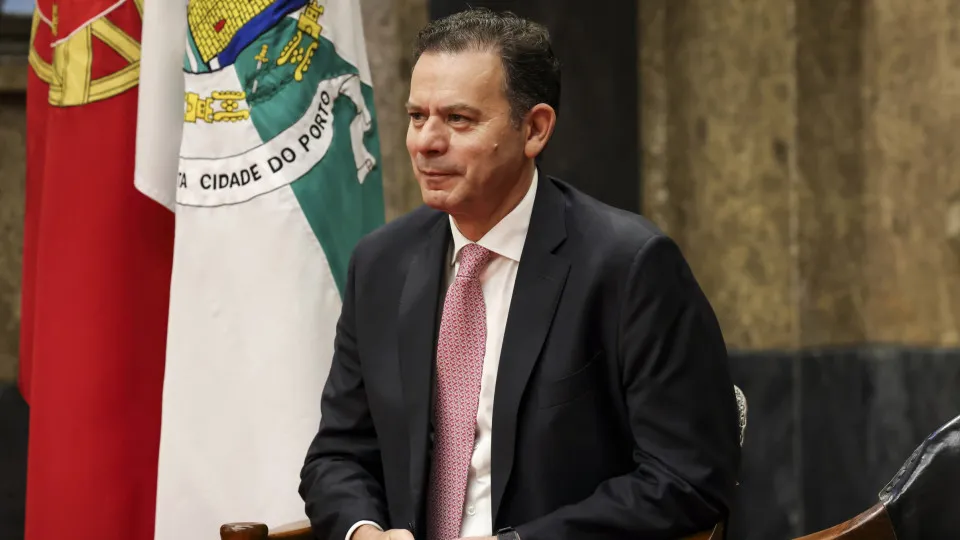
At the opening session of the Portugal-Mozambique Economic Forum, following the sixth bilateral summit between the two countries in Porto, Luís Montenegro addressed criticism from José Luís Carneiro.
The socialist leader remarked on Sunday that it was “undignified” for the prime minister to suggest a “bidding war on salary increases,” after the head of government mentioned a minimum wage of 1,600 euros shortly before a general strike.
In his concluding remarks, Montenegro described the current moment as “singular.”
“When a political leader seeks to motivate and mobilize the country to seize momentum and present new and more ambitious goals, particularly concerning salaries, the opposition desires less, while the political leader, the prime minister, wishes for more. It is the unions that want less and the prime minister who wants more,” he noted with irony.
Montenegro pointed out that usually, the opposite occurs: “Typically, it is the unions and the opposition pushing for more, while the government cautiously evaluates and exercises restraint.”
“This is a positive sign for Portugal. When we have an ambitious government, a prime minister, and a government intent on mobilizing the capabilities of individuals and businesses to go further, and those who do not align with the government’s ideas feel uncomfortable, believe me: the country is on the right path. Political and party disputes should take a back seat, allowing focus on progress,” he urged.
On Saturday, speaking at the Tenth National Congress of Social Democrat Mayors in Porto, the prime minister and PSD president, Luís Montenegro, raised the salary objectives for the country, discussing a minimum wage of 1,600 euros and an average of 3,000 euros, just a day after suggesting lower figures.
“We do not want to grow 2% annually. We aim for 3%, 3.5%, 4%. We want the minimum wage not just to reach 1,100 euros. That’s the goal for this legislature, but we aspire higher. We want it to reach 1,500 or 1,600,” he stated.
The prime minister, who did not address the media upon leaving, avoided mentioning labor laws and the general strike scheduled for Thursday, but emphasized the importance of reforms during favorable economic cycles, adding a note of caution.
“The path is one of reform and transformation. It is not about revolution or abrupt changes. There’s no point in bringing in scare tactics or trying to reintroduce a culture of fear,” he asserted, describing such approaches as disconnected and unrealistic.
The government’s aim, he mentioned, is for “long-lasting, intensive growth cycles that persist over time.”
“That’s why reform is necessary. We must reform to withstand the typical fluctuations in economic cycles, to strengthen favorable cycles and elevate them, but also to minimize losses during less favorable times. That’s the purpose of structural reforms,” he explained.
Montenegro reiterated that the current moment in Portugal-Mozambique relations is about “launching a new cycle” and emphasized that “the watchword is trust,” particularly from the public towards their governments’ directions.
“And we feel that the people are with us, on both sides, believing this is the right path,” he affirmed.
Montenegro again highlighted “The Economist” magazine’s choice of Portugal as economy of the year, citing it as a recognition of “a period of financial, economic, social, and political stability.”
“Without these conditions, being considered economy of the year would not have been possible. Without these conditions, we wouldn’t have been the country that in 2024 most significantly increased workers’ income,” he concluded.