
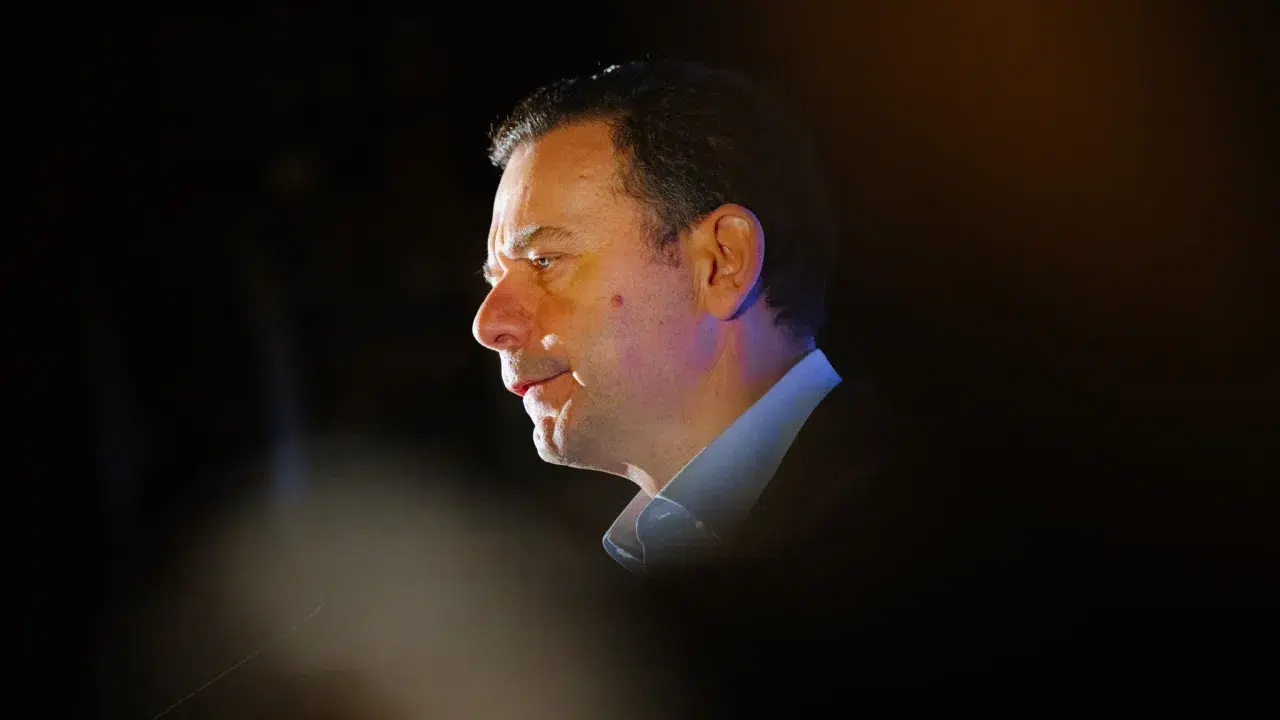
The inauguration of the second government led by Luís Montenegro took place this afternoon at the Ajuda National Palace in Lisbon, following the usual protocol. The President of the Republic arrived at 17:50, wearing a green tie, and did not speak to the press.
The Prime Minister, accompanied by his wife, and the President of the Assembly of the Republic arrived minutes earlier, remaining silent as well.
By 17:00, the future members of the government began to arrive, including the Ombudswoman Maria Lúcia Amaral, who will become the Minister of Internal Administration after this ceremony. She was the first to arrive, taking a taxi.
Among those departing, staying, and newly joining the cabinet, the remarks, when made, were light-hearted and humorous.
“The Portuguese expect a lot from the Government, and we are here full of energy and ambition to continue changing the country,” said António Leitão Amaro, who noted that this “is a continuation of the first opportunity, but now with more strength.”
Leitão Amaro emphasized that the government officials are “very enthusiastic and strong,” a sentiment echoed minutes earlier by Foreign Affairs Minister Paulo Rangel.
“The new Government is stronger because it has been reinforced by the popular vote. It is a continuation of the change that began earlier,” he highlighted.
José Manuel Fernandes, reappointed in Agriculture, remarked that “a Luís Montenegro Government is always strong.”
Nuno Melo, the CDS-PP president, who takes on the defense portfolio again, expressed that this administration “seems” more robust than the previous one.
Among those stepping down, notable was the absence of outgoing Culture Minister Dalila Rodrigues.
Leaving the government but running candidacy for Porto’s Municipality, Pedro Duarte spoke to the journalists more extensively than others, reflecting that “the last elections were clarifying.”
“I believe the Government deserves a different approach from the opposition than what was experienced last year. There was evidently an attempt to wear down the Government from the very start, unfortunately leading to a political crisis,” he stated, calling for the opposition to “act with a sense of state and responsibility.”
Regarding his domain, Duarte noted “noticeable improvement” with the rise of Carlos Abreu Amorim, previously Secretary of State, whom he considers “extremely well-prepared.”
Among the parties, the absence of PCP and BE stood out. Attending oppositional party leaders included only André Ventura of Chega and Carlos César, acting leader of the PS following Pedro Nuno Santos’s resignation.
Ventura reiterated that the Government inaugurated today is a continuation of the previous leadership and envisioned the “same style of governance,” but stressed his party’s pledge to respect the most voted coalition and institutions.
“Chega arrives to assist the country, not the Government—these are different objectives. Assisting the country is preparing an alternative for when it is necessary to become the government alternative,” he advocated.
New Parliamentary Affairs Minister Carlos Abreu Amorim was brief in remarks, predicting that “certainly it will be possible” to reach understandings in Parliament with ten parties.
Contrary to protocol, some individuals arrived after the President, who is typically last, including the Prime Minister’s son, Hugo Montenegro, and Free Parliamentary Leader Isabel Mendes Lopes.