


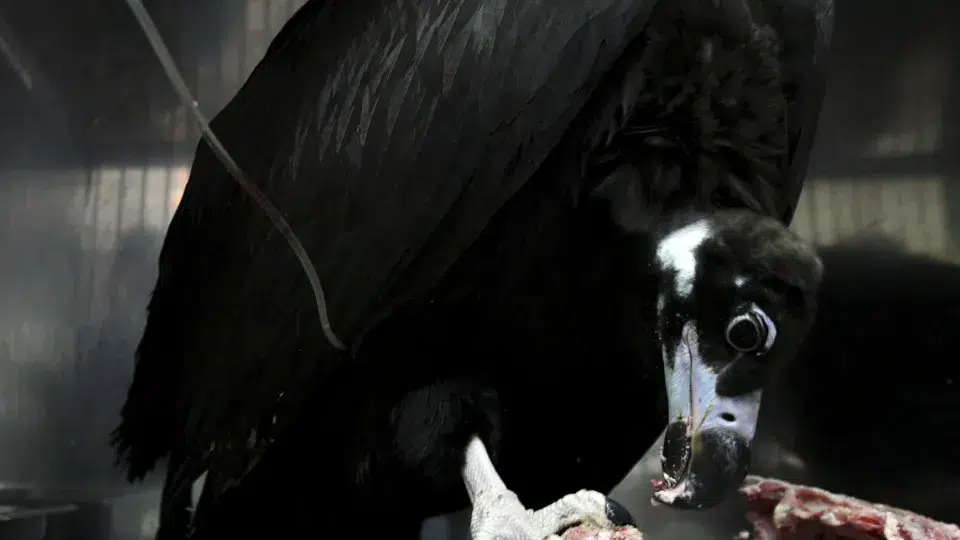
The report was released today by the non-governmental organization “Vulture Conservation Foundation” (VCF), which coordinates the “LIFE Aegypius Return” project. Funded by the European Union’s LIFE program, the project includes partners such as the Institute for Nature Conservation and Forests (ICNF) and the NGOs Rwilding Portugal and Quercus.
The project began three years ago with the aim of doubling the breeding population of black vultures in Portugal, which was estimated at 40 pairs across four colonies.
With the discovery of a fifth colony last year, covering the municipalities of Vidigueira and Portel, the goal shifted to implementing “conservation actions aimed at doubling this number, achieving at least 80 pairs across five colonies by 2027.”
“In the 2025 breeding season, the increase in nesting pairs compared to 2024 (108-116 pairs) was modest: 119 to 126 pairs were recorded, producing 56 chicks recruited into the population,” explained the VCF. It further noted that 25 to 26 of these pairs and 16 chicks are from nests located in Spanish territory, “given that several colonies are transboundary.”
The nesting pairs are distributed across the colonies of Douro Internacional, Serra da Malcata, Tejo Internacional, Herdade da Contenda, and Vidigueira.
The Douro Internacional colony maintained its eight nesting pairs from last year, producing five fledglings, while in Serra da Malcata, the number of pairs decreased from 18 in 2024 to 15 this year.
The organization highlighted several factors impacting the black vulture’s reproduction, including a fire that “burned over 10,000 hectares of the Douro Internacional Natural Park,” which “completely destroyed two nests and affected another six.” Of the five fledglings born, two were confirmed dead, with suspicions of another two deaths.
“The various colonies are also threatened by the rapid expansion of renewable energy projects, with new wind turbines and power lines installed near the nests, increasing the risk of collision and electrocution,” the VCF stated.
The organization added that solar parks “render vast feeding areas or potential expansion areas for the species useless” and that “the black vulture continues to face well-known threats such as poisoning and shooting.”