
The President of the Republic promulgated the decree restricting the use of smartphones in schools on Thursday. This information was disclosed through a note on the presidency’s website, emphasizing consideration of the “favorable opinion of the School Council and the potential pedagogical interest offered by providing an evaluable experience.”
Nevertheless, the communication noted that Marcelo Rebelo de Sousa acknowledged the “reservations of the Association of Private and Cooperative Education Establishments (AEEP), the National Confederation of Parent Associations (CONFAP), and, particularly, the National Education Council (CNE)”, yet chose to proceed differently.
The note also highlights that “the regime applicable to the Autonomous Regions” must take into account “the constitutionally enshrined legislative autonomy.”
The government approved a decree restricting the use of mobile phones in schools up to the 6th grade.
The decree was approved by the Council of Ministers on July 3 and aims to regulate “the use, within the school premises, of electronic devices or equipment with internet access, such as smartphones, prohibiting their use by students in the 1st and 2nd cycles of basic education, starting from the next school year.” Thus, there will be a restriction on the use of mobile phones up to the 6th grade.
According to the government, “the adoption of prohibition or restriction measures considers the results of the study by the Center for Planning and Evaluation of Public Policies on the recommendations issued by the Ministry of Education, Science and Innovation in September 2024 regarding the use of smartphones in school premises.”
The study’s conclusions indicate that more than half of the schools that prohibited smartphone use reported a decrease in bullying and indiscipline from the 2nd cycle to secondary education, and the vast majority saw students socializing more during breaks, engaging in physical activities, and using playgrounds more.
Last year, the Ministry of Education, Science and Innovation recommended prohibiting smartphones from the 1st to the 6th grade, meaning up to age 12, with limited use recommended in the 3rd cycle.
According to the study, only 21.3% of 1st cycle schools did not adopt the recommendation, and 59.1% of 2nd cycle schools also did not comply.
In the 3rd cycle, 24.9% prohibited the use of these devices; at the secondary level, the measure was adopted by only 7.6% of schools.
The most significant impacts on reducing bullying and indiscipline were reported by schools opting for prohibition, especially in the 2nd cycle (59% and 53.6%, respectively), in the 3rd cycle (57.8% and 57.4%), and in secondary education (55.6% and 59.5%).
Conversely, school directors shared challenges in enforcing and implementing the rules, particularly in schools where different educational levels coexist, advocating for phased implementation and an awareness phase.
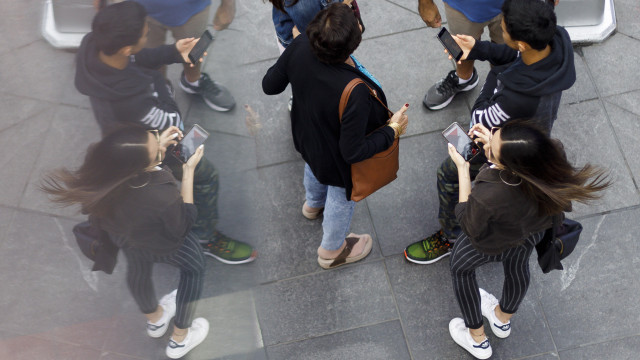
The government today approved the prohibition of mobile phones in schools up to the 6th grade and the revision of the Citizenship and Development discipline, measures to be implemented from the next school year.
[Updated at 16:31]