

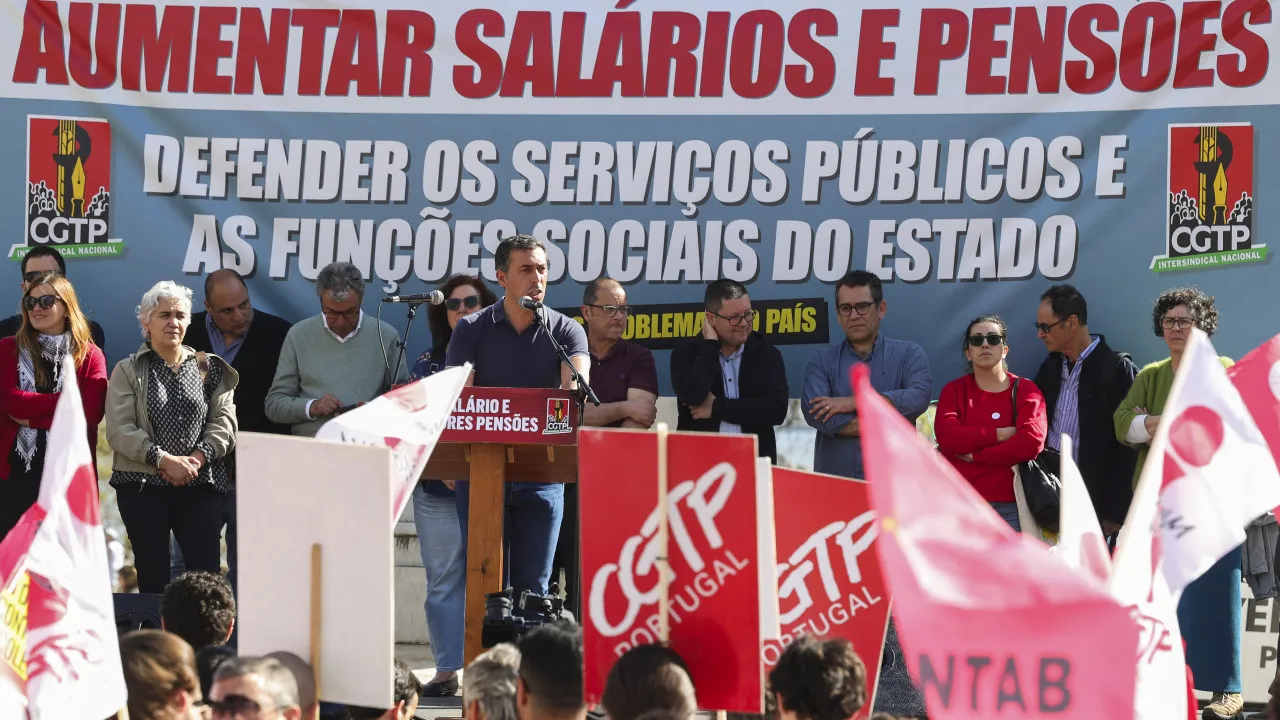
“The workers responded to the call of the CGTP (…) An enormous participation, with great strength, determination, and energy,” emphasized Tiago Oliveira at the conclusion of the march, which saw thousands descending from Príncipe Real to Cais do Sodré, aimed at “defending public services and the social functions of the State.”
“Here, a strong signal is shown, both in terms of the confrontation we must have in companies and workplaces, fighting for a better life, for better wages, for respecting workers’ rights, with a struggle we must bring to the streets, especially in this period of pre-election campaigning. We have the election campaign coming up in a few weeks for the May 18 elections,” he added.
The general secretary of CGTP-IN challenged the political parties competing in the May 18 elections to present their proposals and discussions regarding the appreciation of workers, particularly in fighting precariousness, deregulation of working hours, and also in valuing public services.
Prior to this, in statements to journalists, the general secretary of the PCP, Paulo Raimundo, highlighted that the demonstration organized by CGTP-IN constituted “another great day of struggle” in defense of a “better life,” which the Portuguese are entitled to, characterized by better wages and pensions to address “the drama of the rising cost of living.”
For Paulo Raimundo, increasing wages in Portugal “is an urgency and a necessity,” criticizing the PSD and CDS-PP government for engaging in “propaganda like never before” and governing “in the name of economic groups.”
“The government did not disappoint the expectations of economic groups, but it did disappoint those who believed in it, and the consequences are clear,” lamented the communist leader.
Another party leader present at the demonstration was the leader of LIVRE, Rui Tavares, who expressed that workers represented by unions like CGTP are “one of the best guarantees to fight for good wages and decent working conditions that benefit the national economy.”
“We look abroad to economies we envy, to Scandinavian countries, where collective bargaining is strong and unions possess significant negotiating strength with employers. This often occurs without state intervention, unlike in Portugal, where in the case of public companies, the state sometimes intervenes to tell the Board of Directors that no further negotiation is possible,” he added.
On the other hand, the parliamentary leader of the Left Bloc, Fabian Figueiredo, argued that in Portugal, there are “additional reasons” for the protest organized by CGTP-IN.
“Portugal is a country where, even while working, one cannot escape poverty or secure a home. Three to four million Portuguese earn between 800 and 1,000 euros net. And a one-bedroom or two-bedroom apartment in Lisbon or Porto costs over 1,000 euros. This is the reality of the Portuguese economy,” he criticized.
Fabian Figueiredo further stated that the Portuguese economy “has structural problems that need to be resolved.”
“It is, on one hand, an economy that creates millionaires and great fortunes but also enriches just a small group without generating wages that allow people to meet basic needs. The minimum wage should cover housing costs. Hence, we align with the hundreds taking to the streets today, spending their Saturday to state the obvious: salaries, pensions, and the right to housing should ensure an unfettered life, allowing for work-life balance,” he emphasized.
The demonstration organized by CGTP-IN was under the banner “Higher Wages and Better Pensions – Defend Public Services and the Social Functions of the State – Social Security, Health, Education, Housing,” addressing both the public and private sectors.
In its demands, CGTP calls for a salary increase of at least 15%, with a minimum of 150 euros for all workers, as well as raising the current minimum wage from 870 euros to 1,000 euros.