


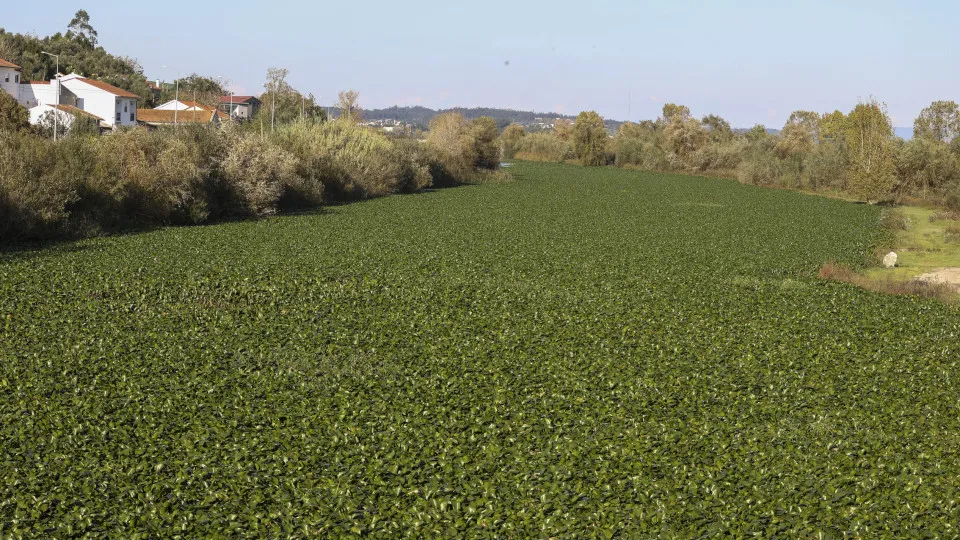
The BioComp 3.0 project brought together a consortium of 13 entities, including companies, higher education institutions, research centers, the Regional Coordination and Development Commission of the Center, and the intermunicipal community of the Coimbra region, over two and a half years to study how to manage biomass resulting from the removal of an invasive aquatic plant from rivers and lakes.
In an interview, Manuel Rodrigues, an agronomy specialist at the Polytechnic Institute of Bragança and coordinator of BioComp 3.0, emphasized that the project’s aim was not to tackle the proliferation of these plants—describing it as “a war between the ecological capacity of the water hyacinth and human ability to remove it”—but rather to determine the fate of the biomass generated by removing it from watercourses.
“The project’s focus is that, while this issue persists and prospects [for resolution] are not encouraging, a lot of biomass is generated. At present, it is unclear what should be done with this biomass,” he stated.
BioComp 3.0 examined numerous variables and workstreams, bringing together more than a dozen entities, each contributing their resources to the consortium, exploring the pathway of composting as a solution for the water hyacinth biomass.
The expert noted that this biomass cannot be used alone as “it does not result in a high-quality compost” and must be combined with other organic residues.
“A comprehensive survey was conducted of all organic residues in the Coimbra region, from livestock manure to agro-industrial materials and forest chips, and some were identified that we initially thought would be good partners for composting with the hyacinth,” he explained.
The two most promising solutions involved creating two different composts, one combining the invasive plant’s biomass with forest chips, “which is very abundant in the region”, and another that adds a percentage of horse manure to these two residues.
Subsequently, these two composts were tested on a variety of agricultural crops to assess their agronomic performance.
For composting to be viable and the resulting products to be commercially available and used by farmers, there must be a consistent raw material supply throughout the year without losing its functional characteristics, which is the case with forest chips, observed the researcher.
However, due to the distinctive properties of water hyacinth biomass—requiring special handling and procedures, particularly concerning its seeds, which can lead to uncontrolled plant proliferation if dispersed in waterways—the next step in this research involves obtaining a set of authorizations and certifications under the responsibility of environmental authorities, aiming at a potential future commercialization.
“The composting and agronomic valorization are somewhat understood. The issue now is the legality of all this. At the moment, I cannot take this [water hyacinth biomass] and compost it; it is illegal, it is prohibited. Being a dangerous invasive species, and with the risk of further spreading, we cannot handle this without legal authorizations being unlocked,” cautioned Manuel Rodrigues.