

From the notes, tickets, and messages left by the grandfather’s home care team during his final days emerged the first novel by author Lisa Ridzén, which became a phenomenon not only in Sweden but in 35 countries where it was published. “When the Birds Fly South” traces the life of Bo, an elderly man facing his increasing lack of autonomy and the consequent separation from his dog, Sixten, his only companion since his wife, Fredrika, was hospitalized.
It is Fredrika to whom Bo narrates his daily life, which, as Lisa Ridzén told Noticias ao Minuto, acted as “a simple way to show how much [he] misses her and how difficult it can be to lose a lifelong partner.”
A sociology doctoral student, the author admitted that she has always been interested “in men and masculinity,” focusing her research on rural communities in the far north of Sweden. This interest poured into fiction, where she sought “to capture the complexity of being,” rather than “reproducing stereotypes of masculinity.” Although men in that region exhibit “silent stoicism [and] some aggression,” they are also “gentle, caring, affectionate, vulnerable, insecure, warm.” The scholar confessed that she will never tire “of hearing that people cried while reading” her work, “especially men.”
Bo narrating his story to his wife, Fredrika, is partly a simple way to show how much he misses her and how difficult it can be to lose a lifelong partner. It was also a narrative choice to showcase the important place our loved ones often still occupy in our thoughts and daily lives, even after they have physically departed.
In other interviews, she shared that Bo’s story came to her when she found the notes caregivers left about her grandfather’s daily life, including his thoughts, mood, and mishaps. What did she feel when she encountered the diary? How much of the book is fact, and how much is fiction?
I was sitting in my father’s workshop, rummaging through old boxes, when I discovered the diaries left by my grandfather’s caregivers. As I flipped through the pages, the character Bo simply came to mind. I remember it being a very strong moment, partly because of the memories it brought of my own grandfather and partly due to the clarity of this new character that suddenly appeared in my head. Unlike my previous writings, Bo and his story – and even the other characters – emerged essentially complete, and I only had to find the words to write and structure the narrative. It felt like Bo was telling his story through me. Is that a cliché of a writer?
The format of the diaries left by my grandfather’s caregivers was very familiar to me, as I had worked as a caregiver myself. The caregivers’ voice became a clear and natural way to introduce an external perspective into a story otherwise entirely told from Bo’s perspective. The book’s notes were taken from my grandfather’s home care records but rewritten to fit Bo’s story.
Bo is particularly close to Ingrid but despises Eva-Lena. Are these characters based on real people (or real caregivers)?
All the characters in the book are, in a way, based on real people, though no character is entirely based on a single person. The caregivers I met, worked with, and heard about from older people are a heterogeneous group, like any other group of people. There are caregivers who are warm and committed, and there are those who dislike their jobs and merely follow their duties to the letter. So, there’s no real-life Eva-Lena, but some aspects of the character are based on aspects of real people. However, I worked with a caregiver who was a great inspiration for the character Ingrid!
Anticipatory grief, things left unsaid, and nostalgia for the past are some of the main themes of the book. In fact, Bo’s interior monologue guides us through the story, where past and present events are intertwined. He also directly addresses his wife, Fredrika, although she is in a continuing care institution due to her dementia. Why did you make these narrative choices? Can you explain your process?
It was important for me to try to create intellectual and physical empathy and closeness with Bo. I wanted the reader to feel as close to Bo as possible, and writing in the first person to the most significant person in his life seemed the most direct way to create that feeling. I also mentioned earlier that I felt Bo was telling his story through me from the moment he appeared in my mind. Therefore, writing the story in Bo’s voice was, in a way, like letting him speak.
Bo narrating his story to his wife, Fredrika, is partly a simple way to show how much he misses her and how difficult it can be to lose a lifelong partner. It was also a narrative choice to showcase the important place our loved ones often still occupy in our thoughts and daily lives, even after they have physically departed. Now I live in my grandfather’s house, and although 15 years have been since his death, I still feel his presence in everyday actions like bringing firewood and lighting the fireplace. Thus, there’s a similarity between my longing for my grandfather and Bo’s longing for his wife. It’s an example of how I tried to create a feeling for and with Bo, relating to real emotions from my own experience in combination with what I learned about the experiences of older people.
Something that also struck me in many older people was how the past seems to become more vivid for them than the present. Mixing the timelines of the past and present was, therefore, partially a tool to recreate that feeling. It also serves other purposes, such as showing changes in masculinity and society over time.
Men and boys, especially in rural areas, are often depicted in literature and other media in a rather stereotypical manner. Of course, there’s some truth to these stereotypes – the silent stoicism, some aggression. But the men here are also gentle, caring, affectionate, vulnerable, insecure, warm
How has your research on men living in sparsely populated areas, particularly in northern Sweden, shaped not just Bo but also Hans, Ture, and even Bo’s father? Did you try to explore different masculinity stereotypes with each of them? If so, which ones?
In a way, the interest I’ve always had in men and masculinity influenced both my writing and my doctoral research. It was that interest that led me to this research and obviously influences my writing. I’ve always been interested in people’s lives, and whenever I can, I research, question, and observe. While writing the book, I often spoke to people I know locally and asked them for details about their experiences, expressions, or thought processes. My academic research also involves delving into the lives of men from different generations and life experiences, but all from this area. Reading the work of others has helped me put these experiences in broader social and historical contexts.
Obviously, for ethical reasons, I did not include any of my academic analyses in my fiction. But the field of masculinity studies provided me with new perspectives on certain aspects of masculinity, and my research (and that of others) gave me a new insight into how Swedish colonial history shapes the identities of men (and all of us) in northern Sweden.
Men and boys, especially in rural areas, are often depicted in literature and other media in a rather stereotypical manner. Of course, there’s some truth to these stereotypes – the silent stoicism, some aggression. But the men here are also gentle, caring, affectionate, vulnerable, insecure, warm. Instead of reproducing masculinity stereotypes or incorporating stereotypes into any of my characters, I wanted to capture the complexity of being. The tensions and gaps where stereotypes unravel or don’t show us valid truths are more interesting to me. To create complete and living characters, it is necessary to go beyond stereotypes.
There are three clearly defined generations of men in the narrative: Hans, Bo, and Karl-Erik. However, they are connected by their difficulty in sharing what they truly feel, so much so that Bo fears his relationship with Hans will be tense because of his own father. Was this your way of showing that we are a product of our environment, even though we also have a role to play in our own growth?
That was definitely one of the aspects. We are a product of our time, context, our relationships with others, and the place we live. This difficulty sharing what they truly feel is a common trait in masculinity throughout their lives, but it’s not static: Bo is far from his father’s way of being, and Hans is even further, as seen in his relationship with his own daughter. But this doesn’t mean telling a story of mere progression and progress: there are difficulties Hans feels that are foreign to Bo, like his relationship with work. One thing I tried to convey was the sense that most people, if not all, are doing the best they can with what they have. Bo struggles until the end to be a better father, a better person, and to leave this world with his relationship with Hans healed.
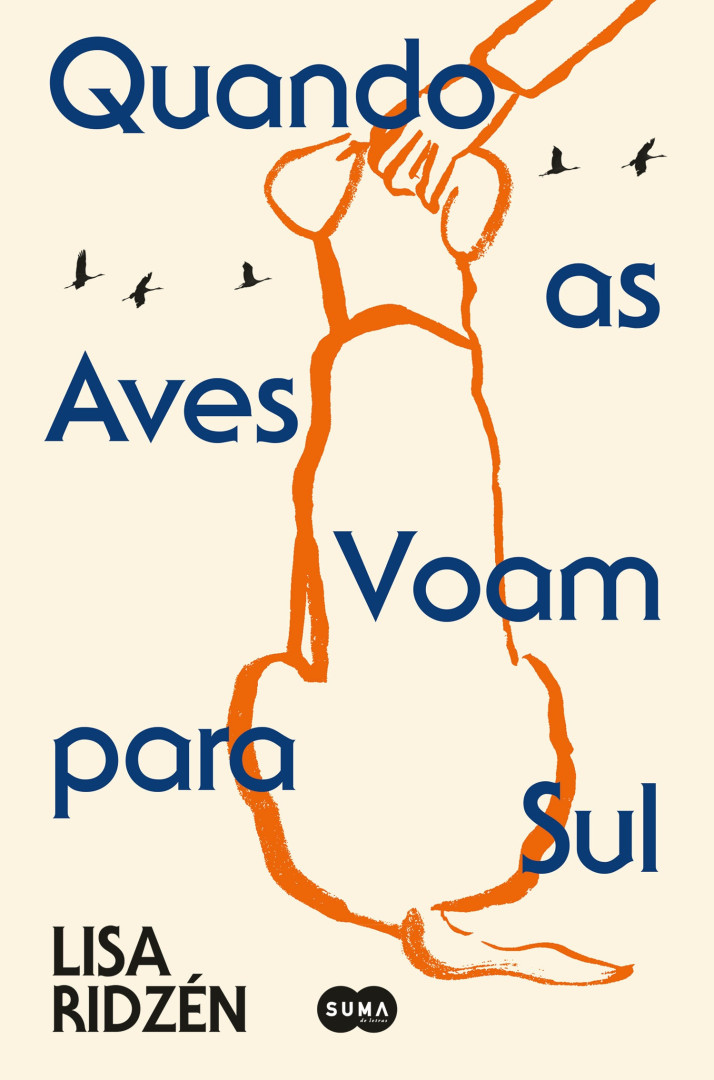 Cover of “When the Birds Fly South”© Penguin Random House
As the story progresses, Bo’s health deteriorates. One of the main conflicts with Hans arises due to his increasing lack of autonomy, which directly affects his ability to care for his dog, Sixten. Is this a situation you witnessed when working as a caregiver? Was it difficult to write about it, given that it’s an emotionally heavy theme?
I did not witness that particular situation, but the loss of autonomy seems to be one of the greatest challenges of aging, and it’s not hard to understand why, in my opinion. I think it’s a big fear for many people. There’s also the perspective of the children: it’s often hard to accept the change in roles. People generally want to help their elderly parents, but it’s not always easy to know what kind of help and how much help to give, or even if it will be considered helpful! The decision deemed most correct by the family, doctors, or caregivers is not necessarily the best for the person. It’s important to try to understand all of someone’s needs if we want to help them more thoroughly. Naturally, there are people who play a minimal or non-existent role in their elderly parents’ lives, and I don’t know if that’s the best solution.
I grew up with dogs and have a dog, Possum. My relationship with her is different from any other in my life. I receive things from her that I can’t get from people, and I can be in a way that I can’t be with people. Many men in the rural areas here have dogs, often hunting dogs, who are also family members and companions. It’s a part of life that I wanted to include. For the elderly, they are just as important as for anyone who loves animals; perhaps even more so, because a dog will always have time, even if others are busy with their own lives. Sixten is more than a companion for Bo – he also gives him physical contact, eye contact, warmth, and smells of another living being. These are things that may be missing when the children leave home and the partner is no longer present. However, overall, it’s not difficult for me to write about emotionally heavy themes, no! The issues addressed in the book are things I constantly think about, and writing about them is, in fact, liberating.
Bo is very close to his granddaughter, Ellinor. Is she based on you in some way?
To some extent, yes! She has a secondary role and is one of the less developed characters in the book, but there are similarities in our relationships with our grandparents and how our lives unfold at the end of their lives.
Living in my grandfather’s house and thinking of Bo so often keeps him present in my life in a way that brings comfort and a sense of belonging and connection. Knowing that I lie in his house exactly where he used to lie and that I wrote a story about his world, would make him proud, I’m sure.
Many readers have confessed that Bo’s story evoked strong emotions in them. Has anyone ever told you that your book made them cry?
Yes, many people! I’m always very happy when I hear that people cried when reading the book because it means I achieved one of my main goals: to make them identify with Bo and feel his story. It also shows me that it’s a story worth telling. I’ll never tire of hearing that people cried while reading “When the Birds Fly South,” especially men!
You revealed in other interviews that your grandfather was abandoned by his mother when he was a baby in Stockholm. What can you tell us about him? What do you think he would say knowing there’s now a book based on the last phase of his life?
In my mind, Bo looks and moves like my paternal grandfather; he lives in my grandfather’s house and moves in my grandfather’s physical world. However, Bo is not my grandfather, and the book is not a diary of my personal experiences. Once, my brother told me, “You have to make sure people understand that Bo is not Grandpa! Grandpa wasn’t bitter and tearful like Bo!” He was a warm and happy man. He was adopted by a family further north and was always grateful for everything he had in life. He lived in the moment and was happy with the little things, even though they didn’t seem small, I suppose! He lived through times of great social change and was also very proud of everything he achieved in life.
I was very close to my grandfather – he lived in our village when I was growing up and ate with us every day. I was always with him and even helped with some care. Living in my grandfather’s house and thinking of Bo so often keeps him present in my life in a way that brings comfort and a sense of belonging and connection. Knowing that I lie in his house exactly where he used to lie and that I wrote a story about his world would make him proud, I’m sure. Everything his family did always made him proud!
And what are you working on currently?
Unfortunately, as I’m on sick leave due to a head injury, I can’t write. I was quite advanced in my next book, but it’s impossible to say when I’ll be able to finish it at this moment. I can say that my next book is set in the same world as “When the Birds Fly South,” but it won’t be about an elderly man. Younger people will be at the center of the narrative, although life’s sorrows and difficulties will also have their place. And there will be even more dogs than in this book!