

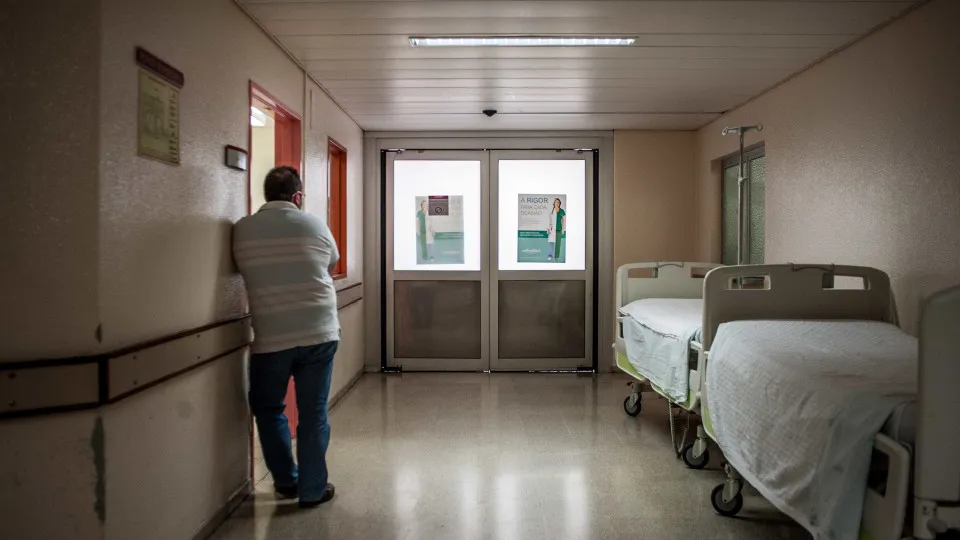
At 8:40 AM today, reports indicated that patients allocated a yellow bracelet (urgent) at Hospital Prof. Doutor Fernando da Fonseca (Amadora-Sintra) faced a wait time of 11 hours and 41 minutes for initial observation.
There was one very urgent patient (orange bracelet) with a wait time of 42 minutes for a first assessment.
In Amadora-Sintra, 10 less urgent patients (green bracelet) were waiting for 11 hours and 29 minutes post-triage to be seen by a doctor.
The executive director of the National Health Service (SNS) stated this week that the emergencies at Hospital Fernando da Fonseca are the main problem of the SNS.
Information available at 8:45 AM on the SNS portal also showed that at the Hospital Santa Maria in Lisbon, urgent patients faced a wait time of one hour and 10 minutes, while at Hospital São José the wait for yellow bracelet patients was only 23 minutes.
At Hospital Garcia de Orta in Almada, there was a one-hour wait for three urgent patients.
At Hospital Beatriz Ângelo in Loures, the SNS portal had no wait time information due to technical constraints in sending information from the health unit.
In the interior, for instance, Hospital Amato Lusitano (Castelo Branco) had only four patients with yellow bracelets waiting, and they had to wait just 18 minutes for the first observation.
In comparison, in the North, at Hospital São João in Porto, urgent patients waited only 17 minutes and at Santo António the wait was 30 minutes.
According to the triage system, very urgent situations (orange bracelet) should be attended to within 10 minutes post-triage, urgent cases (yellow) within 60 minutes, and less urgent (green) within 120 minutes.
Health authorities urge patients to contact the National Health Service Contact Center – SNS24 (808242424) by phone before heading to hospital emergency departments to avoid unnecessary visits.
The Executive Directorate of SNS, in response to increased demand, reported to Lusa that five Local Health Units (ULS) are at maximum contingency level (level 3), another five at an intermediate level (2), and 10 at a minimum level (1).
The DE-SNS also states that the measures implemented vary according to local context. In some levels, there is a provision for temporarily suspending scheduled activity to strengthen the response to acute illness.
In terms of surgeries, priority is being given to outpatient settings, “without compromising oncological surgeries and other priority surgeries,” it notes.
It adds that ULS are contracting beds with the social and private sectors to increase response capacity.