

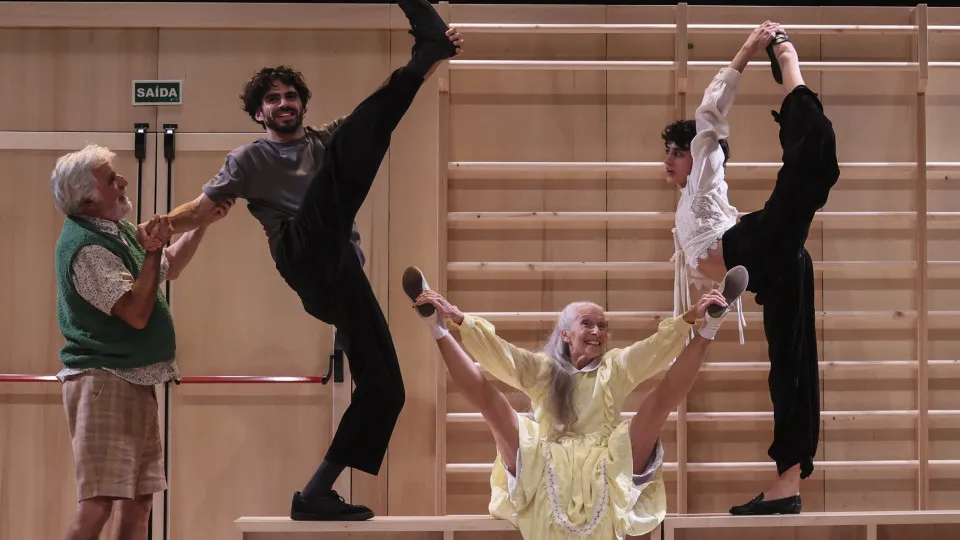
A Companhia Maior, established in 2010, is a performing arts project featuring performers who have reached an advanced age. Contrary to expectations that “A esta hora, na infância neva” would include only artists over 60, the cast comprises individuals from various age groups.
In this production, along with seven members of Companhia Maior, Victor Hugo Pontes chose to involve two dancers and one musician in their 20s and 30s, in addition to six children aged between seven and ten.
“The idea was not to have different generations on stage, but rather different stages of the same person. As if we could explore the physical evolution of bodies at different life moments,” the director explained during rehearsals.
Victor Hugo Pontes has a collaborative approach in his productions, sharing ideas with his performers. “A esta hora, na infância neva” was no exception.
He illustrated the creative process with an evocative analogy shared by Carlos Nery, a 92-year-old performer deeply experienced in theater: “One day he told me, ‘With other directors, we start with the onion and peel away the layers. But with you, we begin at the core and gradually discover the layers, until we have the whole onion.'”
Pontes started from a point of physical exploration: “What are the differences, the contrasts, the gains, and the losses with age?”
“From the physical side of the body and visually, I was interested in building another narrative and projection,” he noted.
Throughout, older performers shared childhood and early adulthood memories, which resonates with the experiences of the younger artists.
“We drew inspiration from these memories along with Dennis Potter’s play ‘Blue Remembered Hills’ and Patti Smith’s memoir ‘Just Kids’,” he said.
Smith’s book, resonating with the older performers, inspired the younger ones by recounting the life experiences of the singer, composer, and poet, at 78.
“It’s as if the younger performers are living the older ones’ lives or symbolizing them in their youth, yet it’s unclear who’s observing whom,” Pontes remarked.
Pontes sees the production’s beauty in this exploration: “Recognizing that these bodies were once agile, children, dynamic, performing.”
The performance includes video projections, showing ‘close-ups’ of performers’ faces, contrasting a 90 or 80-year-old face with a 20-year-old one, illustrating how time physically marks us.
“The pace of actions changes with age; things slow down,” Pontes said.
This juxtaposition also features in photographs of older performers when they were younger.
“There’s a strong identification here; we all have a past and come from somewhere. This is a strength of the show,” he stated.
Although directing Companhia Maior for the first time, Pontes was previously involved in 2013 as an assistant director in “The Visit of the Old Lady”.
The creation and rehearsal processes have been “very enjoyable”.
“I had a lot of fun with both the older and younger performers. The children played a symbolic role—but vital, as they embody a person’s childhood,” Pontes shared.
He noted that older performers often saw themselves in the younger ones’ capabilities and inspirations.
“And indeed, in their minds, they still move like the young, though their bodies are different now, sculpted by time,” Pontes reflected.
“A esta hora, na infância neva” features lines borrowed from Manuel António Pina and debuts Sunday at the Centro Cultural de Belém in Lisbon, with performances on Monday, Wednesday, and Thursday.
The production will tour in 2026, with shows in Ponta Delgada (February 21 at Teatro Micaelense), Barcelos (March 21 at Theatro Gil Vicente), Vila Real (September 26 at Teatro Municipal), Loulé (October 9 at Cineteatro Louletano), and Braga (November 13 at Theatro Circo).